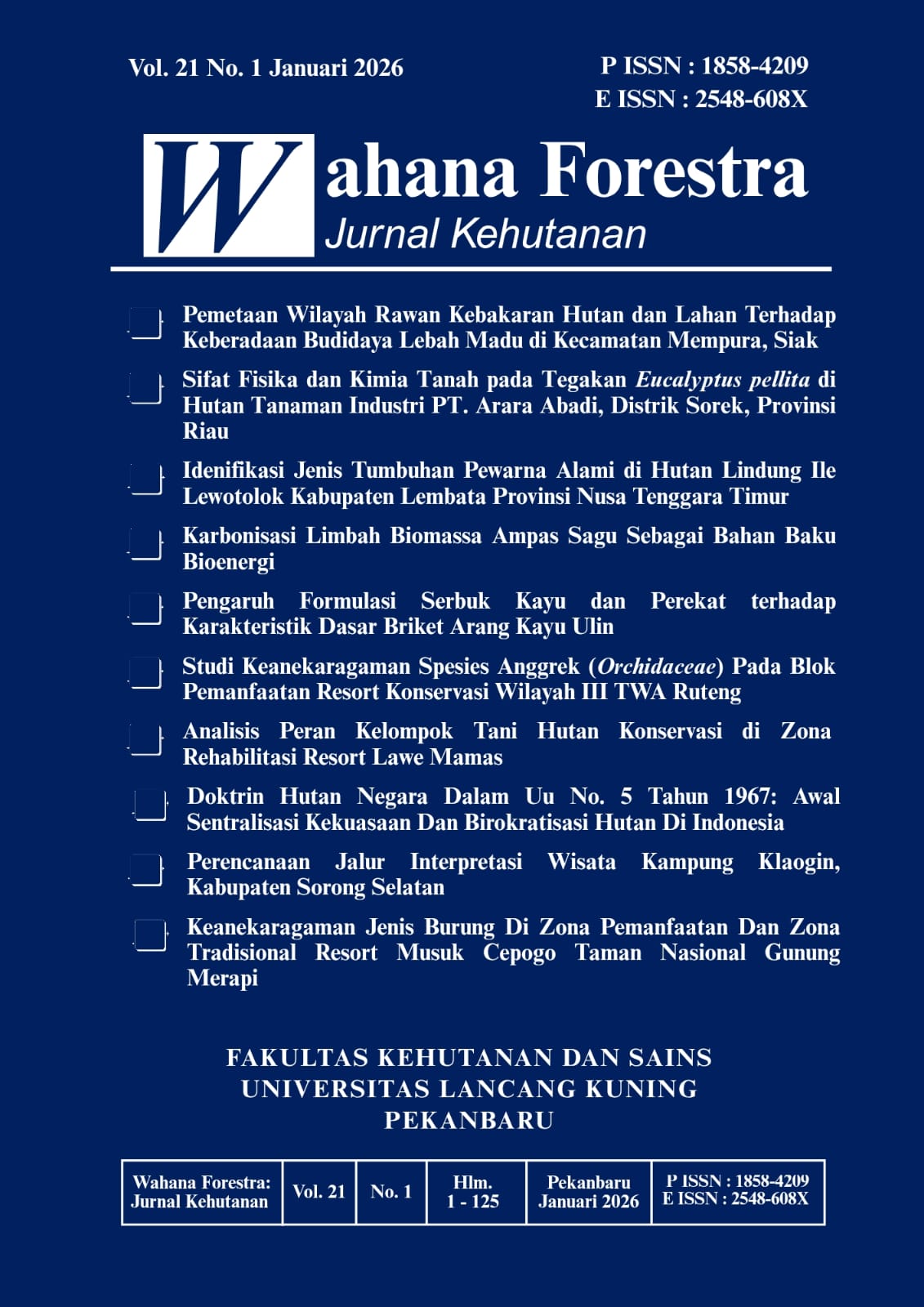
Sifat Fisika dan Kimia Tanah pada Tegakan Eucalyptus pellita di Hutan Tanaman Industri PT. Arara Abadi, Distrik Sorek, Provinsi Riau
DOI:
https://doi.org/10.31849/bnbb3s78Keywords:
Eucalyptus pellita, soil physical properties, soil chemical properties, industrial plantation forestAbstract
Eucalyptus pellita is one of the main species in Industrial Plantation Forests (HTI) due to its rapid growth, short harvesting rotation, high productivity, and resistance to pests and diseases. However, land clearing and repeated harvesting activities may degrade soil physical and chemical properties. This study aimed to analyze the characteristics and differences in soil physical and chemical properties under Eucalyptus pellita stands aged 0–4 years in the Industrial Plantation Forest of PT Arara Abadi, Sorek District, Riau Province. A quantitative descriptive approach was applied with purposive sampling, followed by laboratory analysis. The results revealed that the soil physical properties were dominated by sandy clay loam texture with high bulk density (>1.65 g/cm³). This condition limits nutrient-holding capacity and potentially restricts root growth. Based on the chemical analysis, the soil was classified as very acidic (pH 3.92–4.34), with very low until low Cation Exchange Capacity (2.028–6.931 meq/100g), very low C-Organic (0.25–0.62%), very low until low Nitrogen (0.07–0.12%), very low Phosphorus (0.01–0.02%), and very low Potassium (<0.001–0.02%). These findings indicate a decline in soil quality, both physically and chemically, with increasing stand age.
References
Arifin, A. (2011). Budidaya Tanaman Perkebunan Eucalyptus di PT.Arara Abadi Distrik Sorek. Laporan Praktek Industri. SMKN 1 Siberida. 1–8.
Asril, M., Ningsih, H., Basuki, B., Suhastyo, A. A., Septyani, I. A. putri, Abidin, Z., Mahyati, M., Saadah, T. T., Paulina, M., Siahaan, A. S., Hasfiah, H., & Tang, J. (2023). Kesuburan dan Pemupukan Tanah.
Atzori, M., Gijsberts, A., Castellini, C., Caputo, B., Hager, A. G. M., Elsig, S., Giatsidis, G., Bassetto, F., & Müller, H. (2014). Electromyography data for non-invasive naturally-controlled robotic hand prostheses. Scientific Data, 1, 1–13.
Effendi, K. J., Andayani, S. T., & Wijayani, S. (2023). Pertumbuhan Semai Eucalyptus Pellita pada Berbagai Perlakuan Pemupukan. Agrotechnology, Agribusiness, Forestry, and Technology: Jurnal Mahasiswa Instiper (Agroforetech), 1(1), 780–783.
Erkossa, T., Laekemariam, F., Abera, W., & Tamene, L. (2022). Evolution of soil fertility research and development in Ethiopia: From reconnaissance to data-mining approaches. Experimental Agriculture, 58, 1–13.
FAO-UNESCO. (1981). Soil Map of the World: Digital Soil Map of the World and Derived Soil Properties (1961–1981). In Soil Map of The World: Vol. IX.
Gunawan, G., Wijayanto, N., & Budi, S. W. (2019). Karakteristik Sifat Kimia Tanah dan Status Kesuburan Tanah pada Agroforestri Tanaman Sayuran Berbasis Eucalyptus Sp. Journal of Tropical Silviculture, 10(2), 63–69.
H D, F. (1990). Fundamentals of Soil Science (8th.ed). John Wiley & Sons.
Hardiyanto, E.B., Inail, M.A., Nambiar, E.K.S. 2021. Productivity of Eucalyptus pellita in Sumatra: Acacia mangium legacy, response to phosphorus, and site variables for guiding management. Forests 12(9):1186. (studi Ultisol, data MAI 22,5–34,9; inventori 15,1–39,8; rata-rata 25,2)
Hasibuan, S., & Syafriadiman. (2020). Produktivitas Kualitas Tanah Dasar. In UR Press.
Iskandar, W., Hendrayanto, Muhammad Nizar, Z., & Jung, Y. (2023). Tingkat Bahaya Erosi dan Status Kesuburan Lahan di Area Konsesi Hutan Tanaman Industri di Kalimantan Tengah. Jurnal Ilmu Tanah Dan Lingkungan, 25(2), 46–55.
Kadir, M. dkk. (2023). KesuburanTanah. Jakarta: Yayasan Kita Menulis.
Kusumawati, A. (2015). Buku Ajar Kesuburan Tanah dan Pemupukan (p. 70).
Maharani, P. L. (2014). Manajemen Tempat Tumbuh Tanaman Eucalyptus pellita Di PT Perawang Sukses Perkasa Industri, Riau. Departemen Silvikultur Fakultas Kehutanan Institut Pertanian Bogor.
Mikhailova, E. A., Zurqani, H. A., Post, C. J., Schlautman, M. A., & Post, G. C. (2021). Soil diversity (Pedodiversity) and ecosystem services. Land, 10(3), 1–34.
Moreno-Maroto, J. M., & Alonso-Azcárate, J. (2022). Evaluation of the USDA soil texture triangle through Atterberg limits and an alternative classification system. Applied Clay Science, 229 (January).
Musfal. (2020). Kesuburan tanah dan teknik pengujian status hara. Enam Media.
Nadalia, D., Sutandi, A., Nugroho, B., & Djuniwati, S. (2013). Hubungan antara karakteristik tanah dan produksi tanaman Eucalyptus pellita. Jurnal Tanah Dan Iklim, 37, 119–127.
Office, C. R. U. (University of E. A. dan M. (2021). Data iklim CRU TS v4.06 periode 2011–2020 (Vol. 483).
Permatasari, A. Y. (2023). BAB II Tinjauan Pustaka BAB II Tinjauan Pustaka 2.1. 1–64. Gastronomía Ecuatoriana Y Turismo Local., 1(69), 1–64.
Purin, B. A. (2020). Morfogenesis Eksplan Tunas Eucalyptus pellita F. Muell Secara In Vitro Pada Media Murashige And Skoog Dengan Zat Pengatur Tumbuh Benzil Amino Purin. 45, 299–305.
Puspaningrum, D., & Djabar, M. (2018). Analisis Sifat Fisik Tanah Pada Areal Bekas Tebangan Hutan Tanaman Industri (Hti) Kabupaten Gorontalo Utara Provinsi Gorontalo. Gorontalo Journal of Forestry Research, 1(1), 15.
Puspitorini, P., & Iqbal, G. (2024). Dasar-Dasar Ilmu Tanah. In Proceedings of the National Academy of Sciences (Vol. 3, Issue 1). Mitra Cendikia Media.
RAJA, J. L. (2023). Status Kesehatan Tegakan Eucalyptus pellita Di PT.Wirakarya Sakti. Skripsi, 87(1,2), 149–200.
Riau, P. P. (2018). Peraturan Daerah Provinsi Riau Nomor 10 Tahun 2018 tentang Rencana Tata Ruang Wilayah (RTRW) Provinsi Riau Tahun 2018–2038. Pekanbaru (L. Fahimah (ed.); Pertama). Penerbit Vanda.
Riza, S., Desreza, N., Asnawati, & Sudiyanto. (2019). Pengaruh Karakteristik Fisika Dan Kimia Tanah Terhadap Pertumbuhan Sawi Di Desa Bahway Kecamatan Balik Bukit Kabupaten Lampung Barat. BMC Public Health, 5(1), 1–11.
Rusdiana, O., Rinal, D., & Lubis, S. (2012). Pendugaan Korelasi antara Karakteristik Tanah terhadap Cadangan Karbon (Carbon Stock) pada Hutan Sekunder Estimation Correlation between Soil Characteristics Toward Reserved Carbon (Carbon Stock) in the Secondary Forest. Jurnal Silvikultur Tropika, 3(1), 14–21.
Saputra, P. (2023). Morphological Character and Essential Oil Content of Eucalyptus Pellita. Jurnal Agroteknologi Agribisnis Dan Akuakultur, 3(2), 58–67.
Sulaeman, Suparto, & Eviati. (2005). Analisa Kimiah Tanah, Tanaman, Air dan Pupuk. Balai Penelitian Tanah.
Taisa, R., Purba, T., Sakinah, Herawati, J., Hasibuan, H. syahdia, Junairiah, & Refa, F. (2021). Ilmu Kesuburan Tanah dan Pemupukan. Yayasan Kita Menulis.
Tan, K. (2011). Principles of Soil Chemistry (4th ed). CRC Press.
Wijaya, T.B. (2024). Pemetaan Kelas Kesuburan Tanah Berbasis GIS Di Areal HTI PT.Arara Abadi Kecamatan Tualang Kabupaten Siak. Skripsi Program Studi Agroteknolgi, Fakultas Pertanian, Universitas Islam Negeri Sulthan Syarif Kasim Riau, Pekanbaru. 1–69
Yang, X., Yan, H., Wang, X., & Shang, Q. (2020). Integrated soil fertility and yield trend in response to long-term fertilisation under the chinese double rice-cropping systems. Plant, Soil and Environment, 66(1), 22–32.