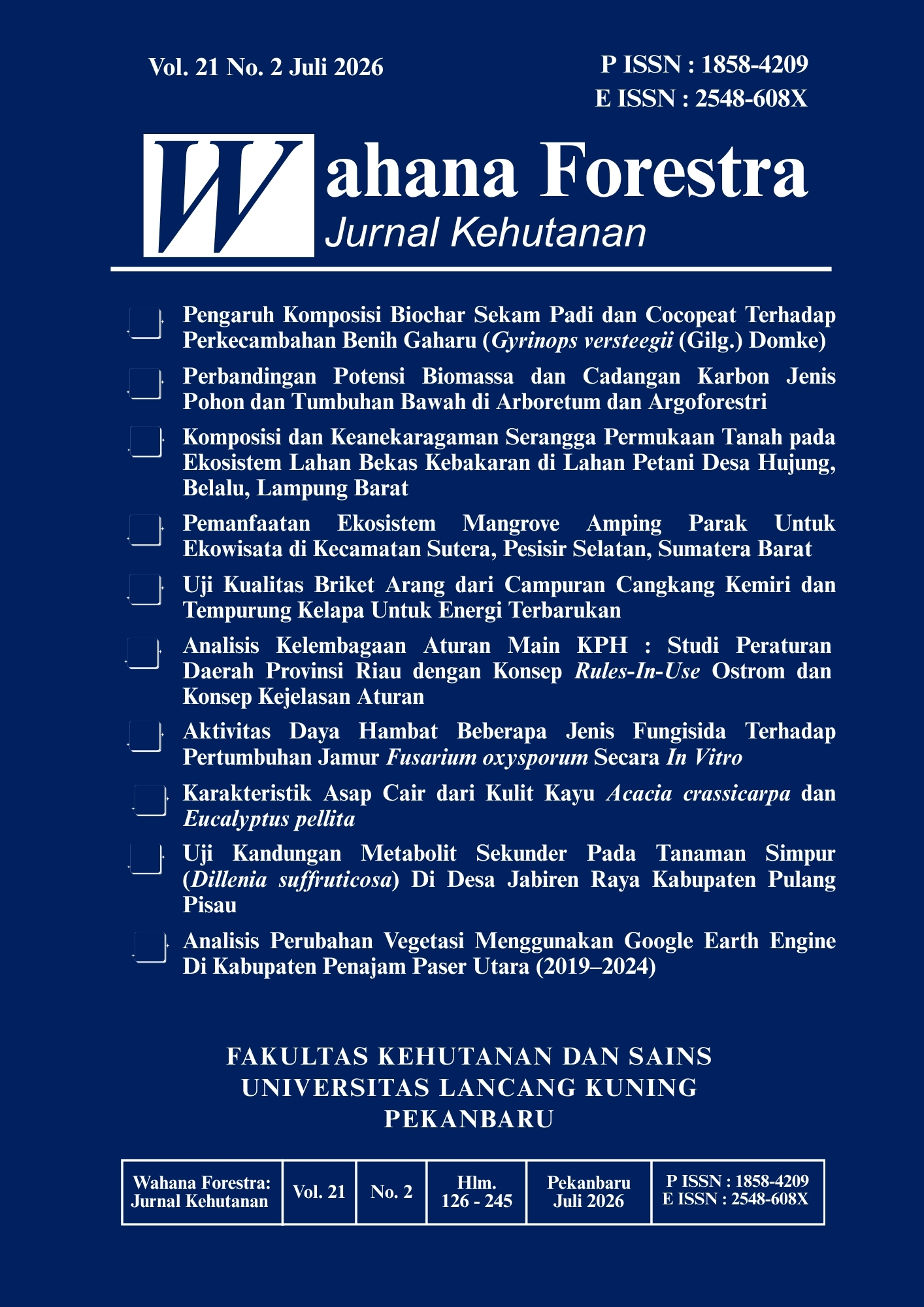
Pengaruh Komposisi Biochar Sekam Padi dan Cocopeat Terhadap Perkecambahan Benih Gaharu (Gyrinops versteegii (Gilg.) Domke)
DOI:
https://doi.org/10.31849/pv7nch76Keywords:
rice husk biochar, cocopeat, agarwood, planting mediaAbstract
Agarwood (Gyrinops versteegii (Gilg.) Domke) is one of Indonesia's non-timber forest product that has high economic value. The agarwood population is declining. This is due to overexploitation and lack of recovery. Therefore, this research is needed to multiply and preserve Agarwood, especially in its natural habitat, by using biochar planting media of rice husk and cocopeat. Rice husk biochar increases the availability of nutrients for plants while cocopeat is known for its aeration properties and maintaining soil moisture. This study aims to determined the effect of various compositions of rice husk biochar and cocopeat on Agarwood seed germination. The study employed a one-factor completely randomized design (CRD) with seven treatments, each of which was repeated three times, yielding 21 experimental units. The treatmeant consisted of B0 (soil 100%), B1 (soil 75% + rice husk biochar 25%), B2 (soil 75% + cocopeat 25%), B3 (soil 25% + rice husk biochar 50% + cocopeat 25%), B4 (soil 25% + rice husk biochar 25% + cocopeat 50%), B5 (soil 50% + rice husk biochar 25% + cocopeat 25%), B6 (rice husk biochar 50% + cocopeat 50%).
References
Ardiyani, M. Wardani W & Sulistyaningsih, L. .. &. Susila. 2019. Barkoding DNA Gaharu Indonesia Menggunakan Marka Dari Genom Kloroplas Dan Genom Inti. Pp. 73–83 in Prosiding Seminar Nasional Konservasi Dan Pemanfaatan Tumbuhan Dan Satwa Liar “Riset Sebagai Pondasi Konservasi Dan Pemanfaatan Tumbuhan Dan Satwa Liar. Bogor: Pusat Penelitian Biologi Lembaga Ilmu Pengetahuan Indonesia.
Cahyaningsih, V. 2018. Respon Pertumbuhan Bibit Dengen (Dillenia Serrata Turb) Terhadap Pemberian Media Tanam Cocopeat Di PT. Vale Indonesia Tbk. Universitas Muhammadiyah Makassar.
Evizal, R., Fembriarti, D., & Prasmatiwi, E. (2023). Biochar: Pemanfaatan Dan Aplikasi Praktis Biochar: Beneficial and Best Practices. Jurnal Agrotropika , 22(1), 1–12.
Haryadi, A. (2016). Pengaruh Residu Biochar Terhadap Pertumbuhan Dan Serapan N Dan K Tanaman Kedelai (Glycine Max L.) Pada Topsoil Dan Subsoil Tanah Ultisol (Vol. 4, Issue June). Universitas Lampung.
Irawan, A. (2015). Pemanfaatan cocopeat dan arang sekam padi sebagai media tanam bibit cempaka wasian (Elmerrilia ovalis). 1, 805–808. https://doi.org/10.13057/psnmbi/m010423
Kuntardina, A., Septiana, W., & Putri, Q. W. (2022). Pembuatan Cocopeat Sebagai Media Tanam Dalam Upaya Peningkatan Nilai Sabut Kelapa. Jurnal Pengabdian Kepada Masyarakat, 6(1), 145–154. http://ejurnal.ikippgribojonegoro.ac.id/index.php/J-ABDIPAMAS
Lehmann, J., & Joseph, S. (2015). Biochar for Environmental Management: An Introduction. Biochar for Environmental Management. 1–13. London. https://doi.org/10.4324/9780203762264
Mattjik, A., & IM, S. (2013). Perancangan Percobaan dengan Aplikasi SAS dan Minitab. IPB Press.
Oktavia A.S. (2022). Pengaruh Penggunaan Media Alternatif Arang Sekam Padi Dan Serbuk Sabut Kelapa (Cocopeat) (Lycopersicum Esculentum Mill) Pengaruh Penggunaan Media Alternatif Arang Sekam Padi Dan Serbuk Sabut Kelapa (Cocopeat) Terhadap Pertumbuhan Tanaman Tomat. Universitas Islam Negeri Ar-Raniry.
Pebriani, E., Okalla, D., & Heriansyah, P. (2023). Pengaruh Biochar Sekam Padi Terhadap Pertumbuhan Bibit Kelapa Sawit (Elaeis Guineensis Jacq) Di Pre Nursery. Jurnal Green Swarnadwipa, 12(1),115–120. https://doi.org/10.14341/diaconfiii25-26.05.23-62
Putri, R. D., Rahmatullah. (2023). Proses Pemanfaatan Limbah Biomassa Kulit Durian (Durio Zibethinus) Menjadi Alternative Fuel Sebagai Langkah Diversifikasi Energi. Bening Media Publishing.
Ramadhan, D., Riniarti, M., & Santoso, T. (2018). Pemanfaatan Cocopeat sebagai Media Tumbuh Sengon Laut (Paraserianthes falcataria) dan Merbau Darat (Intsia palembanica). Jurnal Sylva, 6(2), 22–31.
Sudrajat, D. J., Yuniarti N., Nurhasybi, I., Si, M., Syamsuwida, D., Danu, I., Pramono, A. A., Putri, K. P., & Putri, K. P. 2017. Karakteristik Dan Prinsip Penanganan Benih Tanaman Hutan Berwatak Intermediet Dan Rekalsitran. IPB Press.
Surata, K., & Soenarno, S. (2011). Penanaman Gaharu (Gyrinops versteegii (Gilg.) Domke) Dengan Sistem Tumpangsari Di Rarung, Provinsi Nusa Tenggara Barat. Jurnal Penelitian Hutan Dan Konservasi Alam, 8(4), 349–361. https://doi.org/10.20886/jphka.2011.8.4.349-361
Sutomo, Iryadi, R., & Sumerta, I. M. (2021). Conservation Status of Agarwood-Producing Species (Gyrinops versteegii) in Indonesia. Biosaintifika, 13(2), 149–157. https://doi.org/10.15294/biosaintifika.V13i2.27809
Sutopo, L. (2002). Teknologi Benih. Fakultas Pertanian Universitas Brawijaya.
Verdiana, M. A., Sebayang, H. T., & Sumarni, T. (2016). The Efffect Of Various Doses Biochar Rice Huskand NPK Fertilizer On The Growth And Yield Of Maize (Zea mays L.). Jurnal Produksi Tanaman, 4(8), 611–616.
Widyantika, S. D., & Prijono, S. (2019). Effect of High Doses of Rice Husk Biochar on Soil Physical Properties and Growth of Maize on a Typic Kanhapludult. Jurnal Tanah Dan Sumberdaya Lahan, 06(01), 1157–1163. https://doi.org/10.21776/ub.jtsl.2019.006.1.14
Yulistyarini, T. Rindyastuti, R., Darmayanti, A. S. Budiharta, S Fiqa, A. P. & Siahaan, F. A. (2019). Studi Habitat Dan Variasi Morfologi Gaharu (Gyrinops Versteegii (Gilg.) Domke) Di Kabupaten Manggarai, Flores. Prosiding Seminar Nasional Konservasi Dan Pemanfaatan Tumbuhan Dan Satwa Liar “Riset Sebagai Pondasi Konservasi Dan Pemanfaatan Tumbuhan Dan Satwa Liar, 212–219.