Archives - Page 2

  • Jurnal Ilmiah Pertanian
    Vol. 18 No. 1 (2021)

    Jurnal Ilmiah Pertanian Volume 18 Issue 1 (2021) presents original research articles that examine agricultural systems from multidisciplinary perspectives, encompassing occupational health and safety, agroecology, socio-economic conditions, land resource management, and food consumption behavior. The articles in this issue reflect the journal’s broad scope in agriculture, fisheries, and applied sciences, with a particular focus on human, ecological, and production-related dimensions in tropical and coastal regions of Indonesia. One contribution addresses occupational health and safety in agriculture through an analysis of working postures among oyster mushroom farmers in East Kalimantan using the Ovako Working Posture Analysis System (OWAS). This study highlights ergonomic risks faced by small-scale farmers and provides evidence-based insights for improving labor conditions in agricultural production systems. Complementing the human-centered perspective, another article inventories refugia plants with potential medicinal properties in agricultural landscapes in East Java, emphasizing biodiversity conservation and the multifunctional role of non-crop vegetation in agroecosystems.

    Socio-economic aspects of primary production are explored through a case study of small-scale traditional fishermen in Payum Village, Merauke District, Papua. This article examines livelihood conditions, resource dependence, and socio-economic challenges faced by coastal communities. Production and land resource issues are further addressed in a study analyzing land carrying capacity and production factors influencing cocoa (Theobroma cacao L.) cultivation in Banggai Regency, providing insights into sustainable land use and regional commodity development. The issue also includes a study on community consumption behavior related to sago-based food products in Pekanbaru, Indonesia. This article contributes to the understanding of local food systems, dietary preferences, and the cultural significance of indigenous carbohydrate sources within urban and peri-urban contexts.

    Taken together, the articles in Jurnal Ilmiah Pertanian Volume 18 Issue 1 (2021) demonstrate the integration of technical, ecological, and socio-economic analyses in addressing challenges and opportunities within agricultural and fisheries systems in Indonesia.

  • Jurnal Ilmiah Pertanian
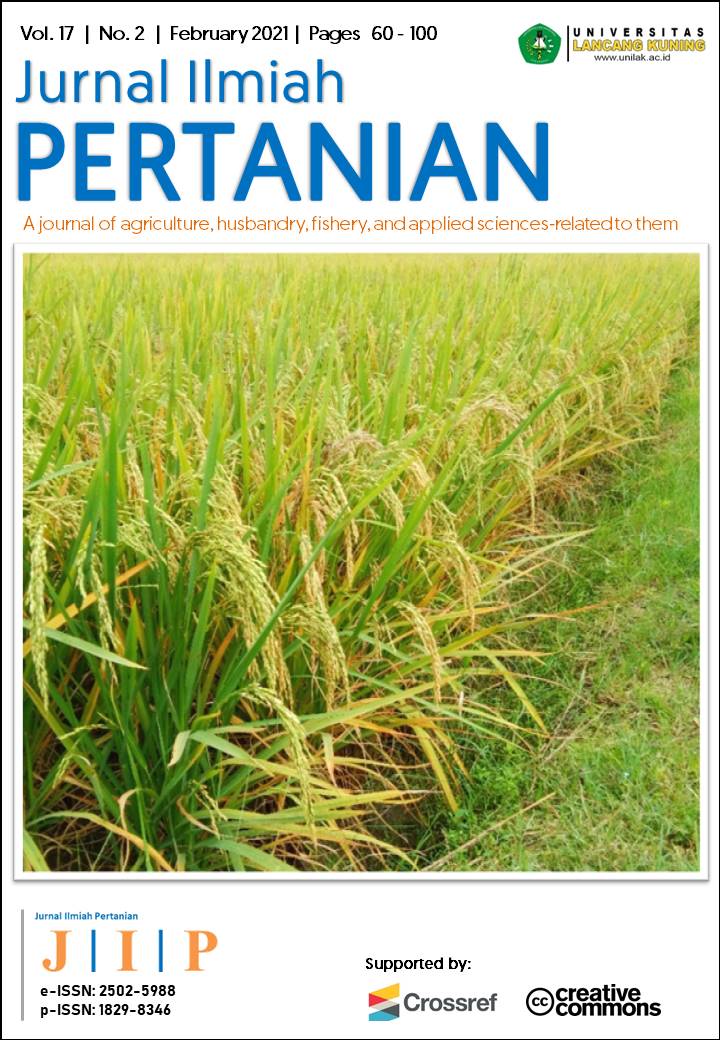
    Vol. 17 No. 2 (2021)

    Jurnal Ilmiah Pertanian Volume 17 Issue 2 (2021) features original research articles that examine sustainable crop production, soil–plant interactions, biological inputs, postharvest quality, and agro-industrial waste utilization in tropical agricultural systems. The articles in this issue focus on environmentally sound management practices, particularly the application of organic amendments, biofertilizers, and biological agents to improve crop performance and resource use efficiency. Several contributions investigate crop growth responses under different soil and fertilization regimes. One study evaluates paddy performance in swampland ecosystems using organic pellet fertilizers derived from Azolla and vermicompost, highlighting their role in supporting rice cultivation in marginal environments. Other studies examine celery (Apium graveolens L.) growth in red-yellow podzolic soils inoculated with earthworms (Pontoscolex corethrurus) and maize root development under N, P, and K fertilization monitored through rhizotron observation, providing insights into root dynamics and nutrient availability.

    The influence of microbial-based inputs is addressed through research on exopolysaccharide-producing Azotobacter combined with cow manure, which assesses nutrient uptake and root-to-shoot ratio in sorghum. This study emphasizes the contribution of beneficial microorganisms and organic matter to plant nutrient acquisition and biomass allocation. Postharvest management and agro-industrial innovation are also represented in this issue. An investigation of Bulog rice storage piles evaluates their effects on rice weevil (Sitophilus oryzae L.) populations and rice quality during storage in Jayawijaya Regency, offering implications for improving grain storage practices. In addition, an agro-industrial study explores the production of nata de cassava from tapioca wastewater using different natural nitrogen sources, demonstrating the potential of agro-industrial by-products as raw materials for value-added food products.

    Together, the articles in Jurnal Ilmiah Pertanian Volume 17 Issue 2 (2021) illustrate the diversity of research approaches addressing soil fertility, crop productivity, postharvest quality, and waste valorization within tropical agriculture.

  • Jurnal Ilmiah Pertanian
    Vol. 17 No. 1 (2020)

  • Jurnal Ilmiah Pertanian
    Vol. 16 No. 2 (2020)

  • Jurnal Ilmiah Pertanian
    Vol. 16 No. 1 (2019)

  • Jurnal Ilmiah Pertanian
    Vol. 15 No. 2 (2019)

  • Jurnal Ilmiah Pertanian
    Vol. 15 No. 1 (2018)

  • Jurnal Ilmiah Pertanian
    Vol. 14 No. 2 (2018)

  • Jurnal Ilmiah Pertanian
    Vol. 14 No. 1 (2017)

  • Jurnal Ilmiah Pertanian
    Vol. 13 No. 2 (2017)

  • Jurnal Ilmiah Pertanian
    Vol. 13 No. 1 (2016)

  • Jurnal Ilmiah Pertanian
    Vol. 12 No. 2 (2016)

  • Jurnal Ilmiah Pertanian
    Vol. 12 No. 1 (2015)

  • Jurnal Ilmiah Pertanian
    Vol. 11 No. 2 (2015)

15-28 of 42