Characterizing agronomic, morphological, nutritional, and phytochemical traits of local sorghum (Sorghum bicolor L.) in Indonesia
DOI:
https://doi.org/10.31849/jip.v21i2.16672Keywords:
local crop analysis, nutritional evaluation, phytochemical profiling, agricultural diversity, sustainable farming practicesAbstract
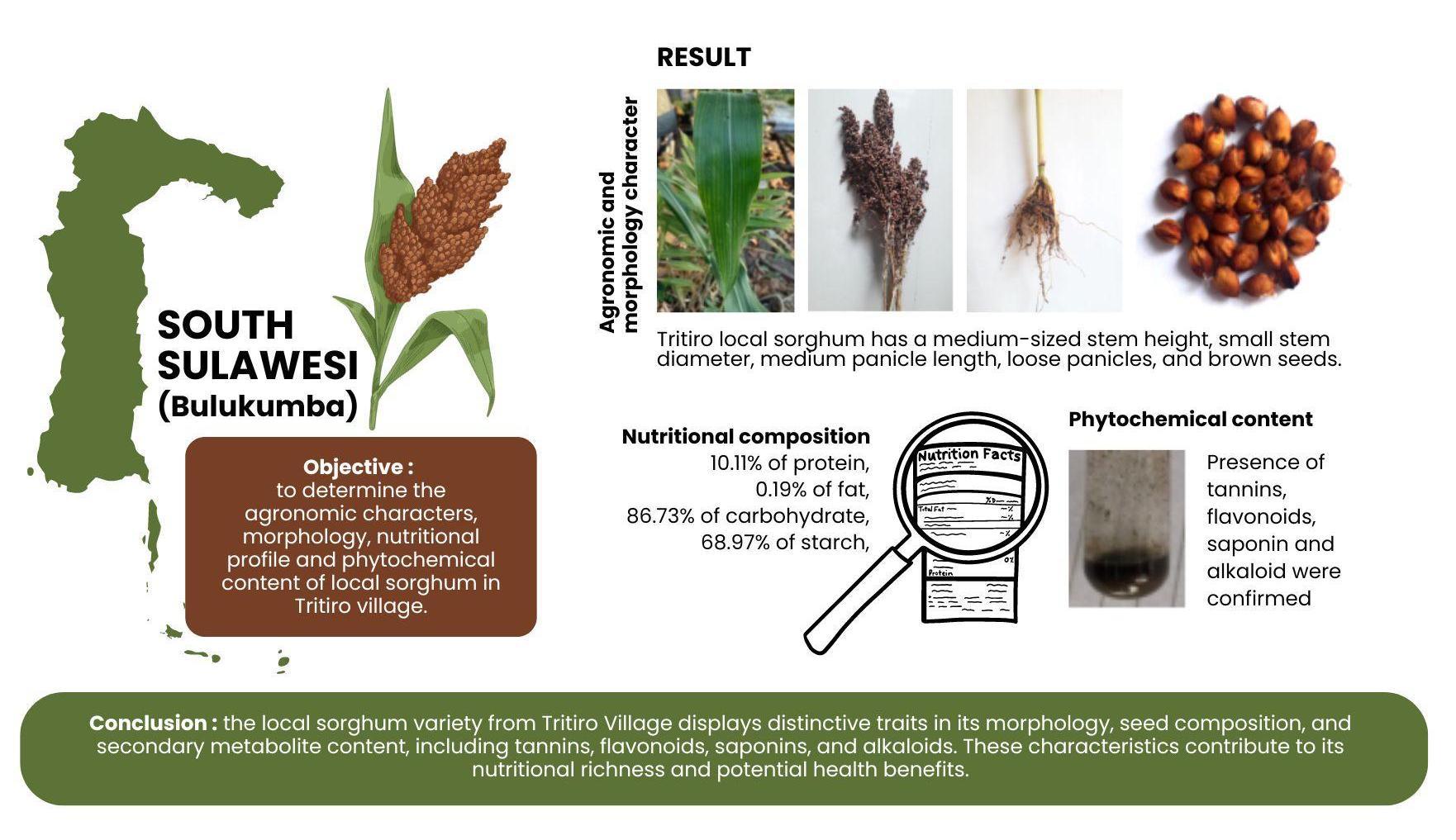
South Sulawesi has been designated by the Ministry of Agriculture, Indonesia, as a key sorghum-producing province. The known sorghum varieties from South Sulawesi include Batara Tojeng Eja, Batara Tojeng Bae, and local sorghum from Jeneponto. In Bulukumba Regency, South Sulawesi Province, Indonesia, local farmers traditionally cultivate local sorghum alongside maize. This study aims to gather information on the agronomic traits, morphological characteristics, nutritional composition, and phytochemical content of local sorghum from Tritiro village, Bulukumba Regency. Agronomic and morphological traits were analyzed through observations of growth and phenotypic features of the leaves, stems, roots, panicles, and seeds of sorghum. Nutritional composition was measured quantitatively, while phytochemical screening was conducted both qualitatively and quantitatively. The results show that local Tritiro sorghum has medium plant height, small stem diameter, medium panicle length, loose panicle shape, and brown seeds. Nutritional analysis revealed that local Tritiro sorghum contains 10.11% protein, 0.19% fat, 86.73% carbohydrates, 68.97% starch, and 9.43 mg g⁻¹ tannins. Local Tritiro sorghum has higher carbohydrate, protein, and fiber content compared to other sorghum varieties from South Sulawesi and exhibits higher tannin content. These findings highlight the potential of local Tritiro sorghum as a valuable nutritional resource and its suitability for cultivation in the region, contributing to food security and sustainable agricultural practices.
References
Aboutalebi, R., & Monfared, A. (2016). Saponin Terpenoids; A Brief Review of Mechanisms of Actions and Anti-cancerous Effects. American Chemical Science Journal, 12(2), 1–8. https://doi.org/10.9734/acsj/2016/20638
Abreha, K. B., Enyew, M., Carlsson, A. S., Vetukuri, R. R., Feyissa, T., Motlhaodi, T., Ng’uni, D., & Geleta, M. (2022). Sorghum in dryland: morphological, physiological, and molecular responses of sorghum under drought stress. Planta, 255(1), 1–23. https://doi.org/10.1007/s00425-021-03799-7
Cardoso, L. de M., Pinheiro, S. S., Martino, H. S. D., & Pinheiro-Sant’Ana, H. M. (2015). Sorghum (Sorghum bicolor L.): Nutrients, bioactive compounds, and potential impact on human health. Critical Reviews in Food Science and Nutrition, 57(2), 372–390. https://doi.org/10.1080/10408398.2014.887057
Cole, M., Eggleston, G., Petrie, E., M Uchimiya, S., & Dalley, C. (2017). Cultivar and maturity effects on the quality attributes and ethanol potential of sweet sorghum. Biomass and Bioenergy, 96(1), 183–192. https://doi.org/10.1016/j.biombioe.2016.12.001
de Oliveira, K. G., Queiroz, V. A. V., Carlos, L. de A., Cardoso, L. de M., Pinheiro-Sant’Ana, H. M., Anunciação, P. C., de Menezes, C. B., Silva, E. C. da, & Barros, F. (2017). Effect of the storage time and temperature on phenolic compounds of sorghum grain and flour. Food Chemistry, 216, 390–398. https://doi.org/10.1016/j.foodchem.2016.08.047
Elangovan, M., Reddy, G. V., Babu, P. K., & Rani, M. J. (2014). Preliminary Evaluation of Mini-core Collections of Sorghum for Utilization. Conference: Global Consultaltion on Millets Promotion for Health & Nutritional Security. Directorate of Sorghum Research. Hyderabad, January, 99–104. https://www.researchgate.net/publication/259842742_Preliminary_evalution_of_Mini-core_collections_of_sorghum_for_utilization
Espitia-Hernández, P., Chávez González, M. L., Ascacio-Valdés, J. A., Dávila-Medina, D., Flores-Naveda, A., Silva, T., Ruelas Chacón, X., & Sepúlveda, L. (2020). Sorghum (Sorghum bicolor L.) as a potential source of bioactive substances and their biological properties. Critical Reviews in Food Science and Nutrition, 62(8), 2269–2280. https://doi.org/10.1080/10408398.2020.1852389
Farrah, S. D., Emilia, E., Mutiara, E., Purba, R., & Tresno Ingtyas, F. (2022). The Effect of Wheat Flour Substitution with Sorghum Flour (Sorghum bicolor, L) on Consumers’ Preference Levels for Cookies. Media Pendidikan Gizi Dan Kuliner, 11(1), 11–18. https://doi.org/10.17509/boga.v11i1.46341
Garfansa, M. P., Windra, K. P., & Sukma. (2021). Translokasi Asimilat Tanaman Jagung (Zea mays L.) Hasil Persilangan Varietas Elos dan Sukmaraga pada Cekaman Garam. Agrovigor: Jurnal Agroekoteknologi, 14(1), 61–65. https://doi.org/10.21107/agrovigor.v14i1.8898
Irawan, A., Putra, T. A., & Ulwia, C. T. (2022). Uji Fitokimia Metabolit Sekunder Daun Ubi Jalar Ungu (Ipomoea batatas (L.) Lamk). Borneo Journal of Pharmascientech, 6(2), 71–74. https://doi.org/10.51817/bjp.v6i2.424
Khalid, W., Ali, A., Arshad, M. S., Afzal, F., Akram, R., Siddeeg, A., Kousar, S., Rahim, M. A., Aziz, A., Maqbool, Z., & Saeed, A. (2022). Nutrients and bioactive compounds of Sorghum bicolor L. used to prepare functional foods: a review on the efficacy against different chronic disorders. International Journal of Food Properties, 25(1), 1045–1062. https://doi.org/10.1080/10942912.2022.2071293
Klocke, N. L., Currie, R. S., Kisekka, I., & Stone, L. R. (2014). Corn and grain sorghum response to limited irrigation, drought, and hail. Applied Engineering in Agriculture, 30(6), 915–924. https://doi.org/10.13031/aea.30.10810
Kusumawati, A., Putri, N. E., & Suliansyah, I. (2013). Karakterisasi dan Evaluasi Beberapa Genotipe Sorgum (Sorghum bicolor L) di Sukarami Kabupaten Solok. Jurnal Agroteknologi, 4(1), 7–12. https://doi.org/10.24014/ja.v4i1.57
Mandasari, P. A., Wirnas, D., Trikoesoemaningtyas, & Sopandie, D. (2020). Differences in Root Morphological Responses of Sorghum Inbred Lines in Low P Conditions. Indonesian Journal of Agronomy, 48(1), 30–36. https://doi.org/10.24831/jai.v48i1.29894
Mohammed, R., Are, A. K., Bhavanasi, R., Munghate, R. S., Kavi Kishor, P. B., & Sharma, H. C. (2015). Quantitative genetic analysis of agronomic and morphological traits in sorghum, Sorghum bicolor. Frontiers in Plant Science, 6(NOVEMBER). https://doi.org/10.3389/fpls.2015.00945
Mohapatra, D., Manoj Kumar, T., Sumedha, D., & Sadvatha, R. H. (2017). Sorghum Fermentation for Nutritional Improvement. Advances in Food Science and Engineering, 1(4), 175–195. https://doi.org/10.22606/afse.2017.14005
Mukkun, L., Lalel, H. J. D., & Kleden, Y. L. (2021). The physical and chemical characteristics of several accessions of sorghum cultivated on drylands in east Nusa Tenggara, Indonesia. Biodiversitas, 22(5), 2520–2531. https://doi.org/10.13057/biodiv/d220509
Noerhartati, E., Hernanda, P. Y., Mujianto, M., Simamora, D., Widiartin, T., Maslihah, M., & Karyanto, N. W. (2020). Sensory evaluation of sorghum cakes: Substituting sorghum flour for rice flour, sticky rice flour and wheat flour. Journal of Physics: Conference Series, 1469(1). https://doi.org/10.1088/1742-6596/1469/1/012132
Ogbaga, C. C., Stepien, P., Dyson, B. C., Rattray, N. J. W., Ellis, D. I., Goodacre, R., & Johnson, G. N. (2016). Biochemical analyses of sorghum varieties reveal differential responses to drought. PLoS ONE, 11(5), 1–20. https://doi.org/10.1371/journal.pone.0154423
Palacios, C. E., Nagai, A., Torres, P., Rodrigues, J. A., & Salatino, A. (2021). Contents of tannins of cultivars of sorghum cultivated in Brazil, as determined by four quantification methods. Food Chemistry, 337(September 2020), 127970. https://doi.org/10.1016/j.foodchem.2020.127970
Penarrieta, J. M., Tejeda, L., Mollinedo, P., Vila, J. L., & Bravo, J. A. (2014). Phenolic compounds in foods. Bolivian Journal of Chemistry, 31(2), 68–81. http://www.scribd.com/bolivianjournalofchemistry
Piluzza, G., Sulas, L., & Bullitta, S. (2014). Tannins in forage plants and their role in animal husbandry and environmental sustainability: A review. Grass and Forage Science, 69(1), 32–48. https://doi.org/10.1111/gfs.12053
Proietti, I., Frazzoli, C., & Mantovani, A. (2015). Exploiting nutritional value of staple foods in the world’s semi-arid areas: Risks, benefits, challenges and opportunities of sorghum. Healthcare (Switzerland), 3(2), 172–193. https://doi.org/10.3390/healthcare3020172
Przybylska, B. A., Frankowski, J., & Stuper-Szablewska, K. (2019). Bioactive compounds in sorghum. European Food Research and Technology, 245(5), 1075–1080. https://doi.org/10.1007/s00217-018-3207-0
Punia, H., Tokas, J., Malik, A., Satpal, & Sangwan, S. (2021). Characterization of phenolic compounds and antioxidant activity in sorghum [Sorghum bicolor (L.) Moench] grains. Cereal Research Communications, 49(3), 343–353. https://doi.org/10.1007/s42976-020-00118-w
Putra, A., Barmawi, M., & Sa’diyah, N. (2015). Penampilan Karakter Agronomi Beberapa Genotipe Harapan Tanaman Kedelai (Glycine max [L.] Merrill) Generasi F6 Hasil Persilangan Wilis x MIg2521. Jurnal Agotek Tropika, 3(3), 348–354. https://doi.org/10.23960/jat.v3i3.1959
Queiroz, V. A. V., da Silva, C. S., de Menezes, C. B., Schaffert, R. E., Guimarães, F. F. M., Guimarães, L. J. M., Guimarães, P. E. de O., & Tardin, F. D. (2015). Nutritional composition of sorghum [Sorghum bicolor (L.) Moench] genotypes cultivated without and with water stress. Journal of Cereal Science, 65, 103–111. https://doi.org/10.1016/j.jcs.2015.06.018
Rahman, A., Anugrahwati, D. R., & Zubaidi, A. (2022). Uji Daya Hasil Beberapa Genotip Tanaman Sorgum (Sorghum bicolor. L Moench) Di Lahan Kering Lombok Utara. Jurnal Ilmiah Mahasiswa Agrokomplek, 1(2), 164–171. https://doi.org/10.29303/jima.v1i2.1448
Razaek, S. A., Kamal, M., Setiawan, K., & Karyanto, A. (2021). Hubungan Karakter Pertumbuhan dan Hasil Beberapa Genotip Sorgum ( Sorghum bicolor [ L .] Moench ) Di Lahan Kering Tanjung Bintang Lampung Selatan. Inovasi Pembangunan-Jurnal Kelitbangan, 9(1), 41–55. https://doi.org/10.35450/jip.v9i01.233
Rebellato, A. P., Orlando, E. A., Thedoropoulos, V. C. T., Greiner, R., & Pallone, J. A. L. (2020). Effect of phytase treatment of sorghum flour, an alternative for gluten free foods and bioaccessibility of essential minerals. Journal of Food Science and Technology, 57(9), 3474–3481. https://doi.org/10.1007/s13197-020-04382-w
Rumler, R., Bender, D., Marti, A., Biber, S., & Schoenlechner, R. (2024). Investigating the impact of sorghum variety and type of flour on chemical , functional , rheological and baking properties. Journal of Cereal Science, 116(July 2023), 103881. https://doi.org/10.1016/j.jcs.2024.103881
Saniaty, A., Trikoesoemaningtyas, & Wirnas, D. (2016). Keragaan Karakter Morfologi dan Agronomi Galur-Galur Sorgum pada Dua Lingkungan Berbeda. Jurnal Agronomi Indonesia (Indonesian Journal of Agronomy), 44(3), 271–278. https://doi.org/10.24831/jai.v44i3.12907
Sarshad, A., Talei, D., Torabi, M., Rafiei, F., & Nejatkhah, P. (2021). Morphological and biochemical responses of Sorghum bicolor (L.) Moench under drought stress. SN Applied Sciences, 3(1), 1–12. https://doi.org/10.1007/s42452-020-03977-4
Setiarto, R. H. B., Nunuk, W., & Iwan, S. (2017). Karakteristik Amilografi Tepung Sorgum Fermentasi dan Aplikasinya pada Produk Cake dan Cookies. Jurnal Dinamika Penelitian Industri, 28(2013), 10–19. https://media.neliti.com/media/publications/77161-ID-none.pdf
Setyorini, D., & Antarlina, S. S. (2022). Secondary metabolites in sorghum and its characteristics. Food Science and Technology (Brazil), 42. https://doi.org/10.1590/fst.49822
Seyoum, Y., Retta, N., & Baye, K. (2016). Nutrient retention and fate of iron-binding phenolic compounds during the injera processing of tannin-free and high-tannin sorghum. Journal of the Science of Food and Agriculture, 96(5), 1541–1547. https://doi.org/10.1002/jsfa.7246
Slamet, A., Hisra, H., & Rajab, R. (2020). The Characteristics of the Morphological Genotypes of Local Sorghum [Sorghum bicolor (L.) Moench] from Buton Selatan. Scientiae Educatia, 9(1), 87. https://doi.org/10.24235/sc.educatia.v9i1.6120
Sondang, Y., & Yulensri. (2021). Karakteristik Morfologi Plasma Nutfah Sorgum Dari Beberapa Daerah Potensial Sumatera Barat. Journal of Food Crop and Applied Agriculture, 1(2), 68–77. https://doi.org/10.32530/jfcaa.v1i2.379
Sugiyama, A. (2021). Flavonoids and saponins in plant rhizospheres: Roles, dynamics, and the potential for agriculture. Bioscience, Biotechnology and Biochemistry, 85(9), 1919–1931. https://doi.org/10.1093/bbb/zbab106
Sulistyowati, D. D., Widiyono, W., Insaniy, G. F. A., & Desmawati, I. (2022). Morfologi Daun Tanaman Sorgum (Sorghum bicolor L) sebagai Respon terhadap Cekaman Kekeringan. Prosiding Seminar Nasional Pembangunan Dan Pendidikan Vokasi Pertanian, 3(1), 643–654. https://doi.org/10.47687/snppvp.v3i1.360
Suryaningsih, R., & Irhas. (2014). Bioenergy plants in indonesia: Sorghum for producing bioethanol as an alternative energy substitute of fossil fuels. Energy Procedia, 47, 211–216. https://doi.org/10.1016/j.egypro.2014.01.216
Trikoesoemaningtyas, Wirnas, D., Saragih, E. L., Rini, E. P., Sari, M., Marwiyah, S., & Sopandie, D. (2017). Kendali Genetik Karakter Morfologi dan Agronomi pada Tiga Populasi Sorgum ( Sorghum bicolor ( L .) Moench ). J. Agron. Indonesia, 45(3), 285–291. https://doi.org/10.24831/jai.v45i3.18387
Utami, I. P., Supriyanta, Fatmawati, & Syahruddin, K. (2022). Karakterisasi Delapan Galur Harapan Sorgum Manis (Sorghum Bicolor L . Moench). Vegetalika, 11(3), 233–245. https://doi.org/10.22146/veg.42804
Wahyono, T., Sugoro, I., Jayanegara, A., Wiryawan, K. G., & Astuti, D. A. (2019). Nutrient Profile and In vitro Degradability of New Promising Mutant Lines Sorghum as Forage in Indonesia. Advances in Animal and Veterinary Sciences, 7(9), 810–818. https://doi.org/10.17582/journal.aavs/2019/7.9.810.818
Wasaki, J., Sakaguchi, J., Yamamura, T., Ito, S., Shinano, T., Osaki, M., & Kandeler, E. (2018). P and N deficiency change the relative abundance and function of rhizosphere microorganisms during cluster root development of white lupin (Lupinus albus L.). Soil Science and Plant Nutrition, 64(6), 686–696. https://doi.org/10.1080/00380768.2018.1536847
Widowati, S., & Luna, P. (2022). Nutritional and Functional Properties of Sorghum (Sorghum bicolor (L.) Moench)-based Products and Potential Valorisation of Sorghum Bran. IOP Conference Series: Earth and Environmental Science, 1024(1). https://doi.org/10.1088/1755-1315/1024/1/012031
Winarti, C., Arif, A. B., Budiyanto, A., & Richana, N. (2020). Sorghum development for staple food and industrial raw materials in East Nusa Tenggara, Indonesia: A review. IOP Conference Series: Earth and Environmental Science, 443(1). https://doi.org/10.1088/1755-1315/443/1/012055
Xiong, Y., Zhang, P., Warner, R. D., & Fang, Z. (2019). Sorghum Grain: From Genotype, Nutrition, and Phenolic Profile to Its Health Benefits and Food Applications. Comprehensive Reviews in Food Science and Food Safety, 18(6), 2025–2046. https://doi.org/10.1111/1541-4337.12506
Yu, J., Yan, F., Lu, Q., & Liu, R. (2018). Interaction between sorghum procyanidin tetramers and the catalytic region of glucosyltransferases-I from Streptococcus mutans UA159. Food Research International, 112(May), 152–159. https://doi.org/10.1016/j.foodres.2018.06.027