Morphological and biochemical identification of Ralstonia solanacearum strains in ginger (Zingiber officinale Roscoe) wilt disease
DOI:
https://doi.org/10.31849/jip.v21i2.19616Keywords:
bacterial pathogen characterization, ginger crop diseases, plant pathogen identification, biochemical assays, agricultural disease managementAbstract
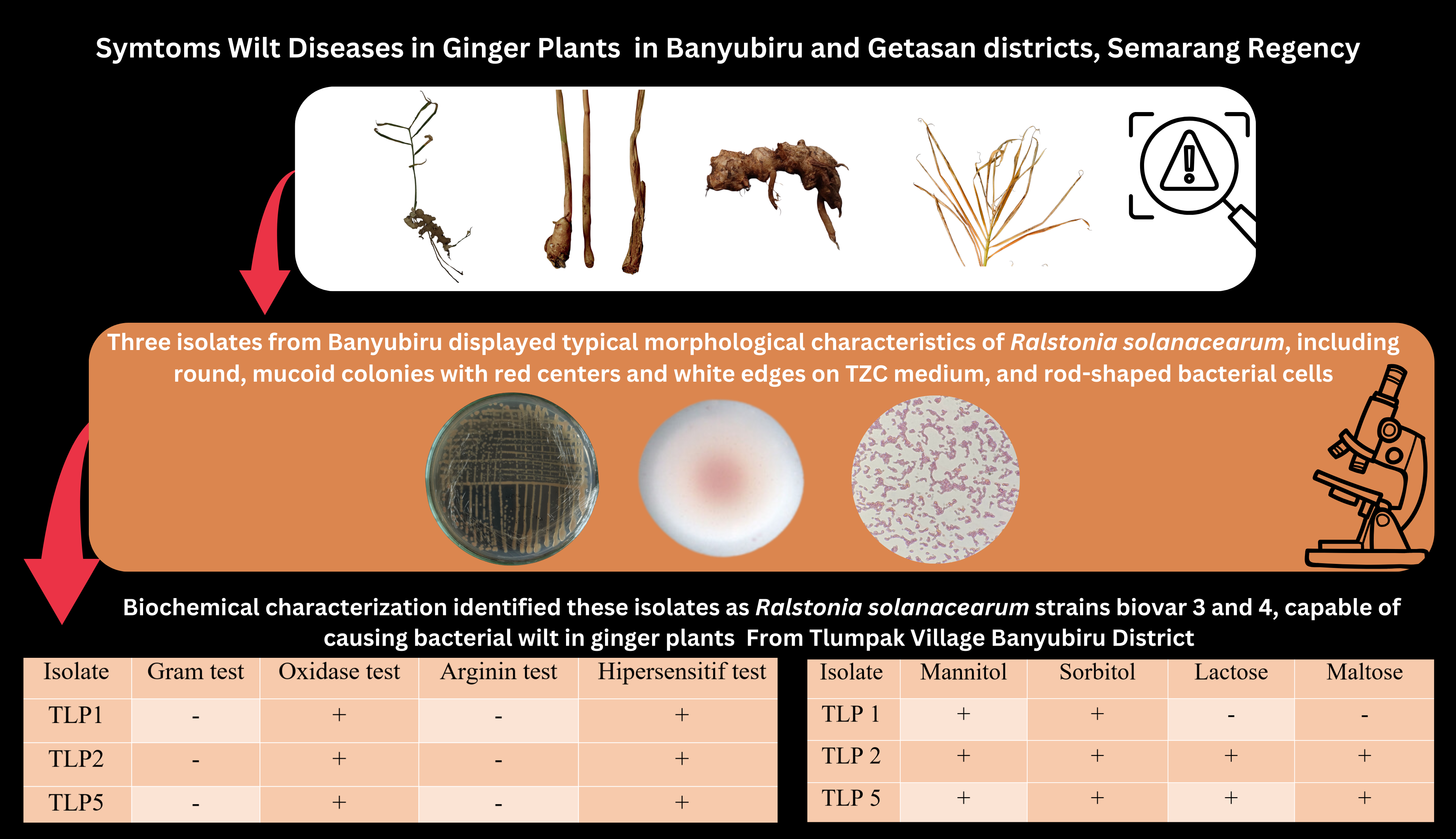
The Ralstonia solanacearum Species Complex (RSSC) is a significant plant pathogen affecting various agricultural commodities, including ginger. Understanding the distribution and characteristics of RSSC in ginger plants is crucial for effective disease management. This study aims to determine the distribution of RSSC in ginger plants and identify the pathogen through morphological and biochemical characterization. The research was conducted in Banyubiru and Getasan districts, Semarang Regency, Indonesia. The study involved purposive sampling, isolation, and purification of isolates, followed by morphological characterization through observation and biochemical characterization using Gram staining with KOH, oxidase test, arginine activity test, hypersensitivity test, bacterial density calculation, Koch's postulates, and biovar characterization. Three isolates from Banyubiru displayed typical morphological characteristics of RSSC, including round, mucoid colonies with red centers and white edges on TZC medium, and rod-shaped bacterial cells. Biochemical characterization identified these isolates as RSSC strains biovar 3 and 4, capable of causing bacterial wilt in ginger plants. The study confirmed the presence of bacterial wilt in ginger in Banyubiru district. The findings reveal the spread of bacterial wilt caused by RSSC in ginger plants in Banyubiru, Semarang Regency. There is a need for measures to control the potential spread of RSSC in the surrounding host plant areas in Tlumpak Village, Banyubiru district.
References
An, Y., & Zhang, M. (2024). Advances in understanding the plant-Ralstonia solanacearum interactions: unraveling the dynamics, mechanisms, and implications for crop disease resistance. New Crops, 1, 100014, 1-11. https://doi.org/10.1016/j.ncrops.2024.100014
Arwiyanto, T. (2014, October 4). Ralstonia solanacearum: biologi penyakit yang ditimbulkan dan pengelolaannya [UGM Press]. https://ugmpress.ugm.ac.id/id/product/pertanian/ralstonia-solanacearum-biologi-penyakit-yang-ditimbulkan-dan-pengelolaannya
Behera, S., Sial, P., Biswal, G., & Pradhan, K. (2020). Ralstonia solanacearum the causal agent of ginger bacterial wilt—A review. International Journal of Current Microbiology and Applied Sciences, 9(12), 2709–2715. https://doi.org/10.20546/ijcmas.2020.912.321
BPS. (2022, February 25). Badan pusat statistik kabupaten semarang [Press release]. https://semarangkab.bps.go.id/publication/2022/02/25/249402c0e3ae914ff4f52186/kabupaten-semarang-dalam-angka-2022.html
Choliq, F. A., Martosudiro, M., Istiqomah, I., & Nijami, M. F. (2020). Isolasi dan uji kemampuan bakteriofag sebagai agens pengendali penyakit layu bakteri (Ralstonia solanacearum) pada tanaman tomat. VIABEL: Jurnal Ilmiah Ilmu-Ilmu Pertanian, 14(1), 8-20. https://doi.org/10.35457/viabel.v14i1.996
Choudhary, D. K., Nabi, S. U., Dar, M. S., & Khan, K. A. (2018). Ralstonia solanacearum: a wide spread and global bacterial plant wilt pathogen. Journal of Pharmacognosy and Phytochemistry, 7(2), 85–90. https://www.phytojournal.com/archives/2018.v7.i2.3077/ralstonia-solanacearum-a-wide-spread-and-global-bacterial-plant-wilt-pathogen
Clough, S. E., Elphinstone, J. G., & Friman, V. P. (2024). Plant pathogenic bacterium Ralstonia solanacearum can rapidly evolve tolerance to antimicrobials produced by Pseudomonas biocontrol bacteria. Journal of Evolutionary Biology, 37(2), 225–237. https://doi.org/10.1093/jeb/voae002
Elpawati, E., Wirhanti, P. E., & Aisyah, S. N. (2022). Forecasting Indonesia’s ginger export with major competing countries in the international market. Anjoro: International Journal of Agriculture and Business, 3(2), 73-80. https://doi.org/10.31605/anjoro.v3i2.2061
García, R. O., Kerns, J. P., & Thiessen, L. (2019). Ralstonia solanacearum species complex: A quick diagnostic guide. Plant Health Progress, 20(1), 7–13. https://doi.org/ 10.1094/PHP-04-18-0015-DG
Hanudin, H., Budiarto, K., Marwoto, B., 2014. Identification of Ralstonia solanacearum Isolated from a New Host : Cosmos caudatus in Indonesia. BIOTROPIA 21(1), 25–37. https://doi.org/10.11598/btb.2014.21.1.340
Hemelda, N. M., Safitri, R., & Suhandono, S. (2019). Genetic diversity of Ralstonia solanacearum, a phytopathogenic bacterium infecting horticultural plants in Java, Indonesia. Biodiversitas Journal of Biological Diversity, 20(2), 364-372. https://doi.org/10.13057/biodiv/d200209
Herdiyantoro, D., Setiawati, M. R., & Simarmata, T. (2022). Reaksi hipersensitif daun tembakau oleh isolat bakteri pelarut kalium pada praformulasi pupuk hayati. Soilrens, 20(2), 72-77. https://doi.org/10.24198/soilrens.v20i2.45266
Kannan, V., Bastas, K., & Rajendran, S. (2015). Scientific and economic impact of plant pathogenic bacteria (pp. 369–392). CRC Press. https://doi.org/10.1201/b18892-21
Khan, M. I., Rehman, M. U., Khan, I., Shah, T. A., Aziz, T., Alharbi, M., Alshammari, A., & Alasmari, A. F. (2024). Isolation, identification and characterization of Xanthomonas Axonopodis PV. citri from selected species. Applied Ecology and Environmental Research, 22(1), 665–679. https://doi.org/10.15666/aeer/2201_665679
Kumar, S., Nath, K., Hamsaveni, N., Gowda, P. H. R., Rohini, I. B., Rangaswamy, K. T., & Achari, R. (2017). Isolation and characterization of Ralstonia solanacearum causing bacterial wilt of solanaceae crops. International Journal of Current Microbiology and Applied Sciences, 6(5), 1173-1190. https://doi.org/10.20546/ijcmas.2017.605.128
Kwon, J.-S., Nam, J.-Y., Yeom, S.-I., Kang, W.-H., 2021. Leaf-to-Whole Plant Spread Bioassay for Pepper and Ralstonia solanacearum Interaction Determines Inheritance of Resistance to Bacterial Wilt for Further Breeding. Int J Mol Sci, 22(2279), 1-14. https://doi.org/10.3390/ijms22052279
Navitasari, L., Joko, T., Murti, R. H., & Arwiyanto, T. (2022). Aplikasi actinomycetes dan bakteriofag pada tomat sambung untuk mengendalikan penyakit layu bakteri Ralstonia solanacearum dan meningkatkan hasil buah. Jurnal Ilmu Pertanian Indonesia, 27(4), 521-527. https://journal.ipb.ac.id/index.php/JIPI/article/view/41055
Nurdika, A. A. H., Arwiyanto, T., & Sulandari, S. (2022). Physio-biochemical, molecular characterization, and phage susceptibility of Ralstonia pseudosolanacearum associated with tomato (Solanum lycopersicum) and eggplant (Solanum melongena). Biodiversitas Journal of Biological Diversity, 23(10), 5149-5158. https://doi.org/10.13057/biodiv/d231022
Nurhidayati, M., Basri, S., & Darmayuda, D. (2022). Competitiveness of Indonesian ginger exports to Japan, Malaysia, and The United States. Keynesia : International Journal of Economy and Business, 1(2), 72-78. https://smujo.id/biodiv/article/view/11913
Paudel, S., Dobhal, S., Alvarez, A. M., & Arif, M. (2020). Taxonomy and phylogenetic research on Ralstonia solanacearum species complex: A complex pathogen with extraordinary economic consequences. Pathogens, 9(11), 11. https://doi.org/10.3390/pathogens9110886
Pooja, R., & Rw, I. (2023). Isolation and biochemical characterization of Ralstonia solanacearum of chilli. The Pharma Innovation Journal, 12(10), 27–31. https://www.thepharmajournal.com/archives/?year=2023&vol=12&issue=10&ArticleId=23492
Prameela, T. (2020). Bacterial wilt of ginger (Zingiber officinale Rosc.) incited by Ralstonia pseudo:solanacearum-a review based on pathogen diversity, diagnostics and management. Journal of Plant Pathology, 102(3), 709-719. https://www.jstor.org/stable/48741499
Ramesh, R., Achari, G. A., & Gaitonde, S. (2014). Genetic diversity of Ralstonia solanacearum infecting solanaceous vegetables from India reveals the existence of unknown or newer sequevars of phylotype I strains. Eur J Plan Pathol, 140(1), 543–562. https://link.springer.com/article/10.1007/s10658-014-0487-5
Ray, J. D., Subandiyah, S., Rincon-Florez, V. A., Prakoso, A. B., Mudita, I. W., Carvalhais, L. C., Markus, J. E. R., O’Dwyer, C. A., & Drenth, A. (2021). Geographic expansion of banana blood disease in Southeast Asia. Plant Disease, 105(10), 2792-2800. https://doi.org/10.1094/PDIS-01-21-0149-RE
Razia, S., Chowdhury, M. S. M., Aminuzzaman, F. M., Sultana, N., & Islam, M. (2021). Morphological, pathological, biochemical and molecular characterization of Ralstonia solanacearum isolates in Bangladesh. American Journal of Molecular Biology, 11(04), 142-164. https://doi.org/10.4236/ajmb.2021.114012
Rusnaldi, K. A., Roessali, W., & Nurfadillah, S. (2023). Analisis daya saing ekspor jahe Indonesia di pasar internasional. Mimbar Agribisnis : Jurnal Pemikiran Masyarakat Ilmiah Berwawasan Agribisnis, 9(1), 515-528. https://doi.org/10.25157/ma.v9i1.8672
Saridewi, L. P., Prihatiningsih, N., & Djatmiko, H. A. (2020). Characterization of eggplant endophyte bacteria and rhizobacteria as well as their antagonistic ability against Ralstonia solanacearum. Jurnal Hama dan Penyakit Tumbuhan Tropika, 20(2), 150-156. https://doi.org/10.23960/j.hptt.220150-156
Schachterle, J. K., & Huang, Q. (2021). A high-throughput virulence screening method for the Ralstonia solanacearum species complex. Journal of Microbiological Methods, 187(106270, 1-8. https://doi.org/10.1016/j.mimet.2021.106270
Schug, A. R., Bartel, A., Meurer, M., Scholtzek, A. D., Brombach, J., Hensel, V., Fanning, S., Schwarz, S., & Feßler, A. T. (2020). Comparison of two methods for cell count determination in the course of biocide susceptibility testing. Veterinary Microbiology, 251, 108831. https://doi.org/10.1016/j.vetmic.2020.108831
Seniati, S., Marbiah, M., & Irham, A. (2019). Pengukuran kepadatan bakteri Vibrio harveyi secara cepat dengan menggunakan spectrofotometer. Agrokompleks, 19(2), 12-19. https://doi.org/10.51978/japp.v19i2.137
Wicker, E., Lefeuvre, P., de Cambiaire, J. C., Lemaire, C., Poussier, S., & Prior, P. (2012). Contrasting recombination patterns and demographic histories of the plant pathogen Ralstonia solanacearum inferred from MLSA. The ISME Journal, 6(5), 961--974. https://doi.org/10.1038/ismej.2011.160
Yusriadi, Abadi, A. L., & Djauhari, S. (2020). Testing of biovar and pathogenicity Ralstonia solanacearum in banana (kepok: local Indonesia) in South Kalimantan, Indonesia. Plant Pathology Journal, 19(2), 114-120. https://doi.org/10.3923/ppj.2020.114.120
Zhang, J., Guo, T., Wang, P., Tian, H., Wang, Y., & Cheng, J. (2018). Characterization of diazotrophic growth-promoting rhizobacteria isolated from ginger root soil as antagonists against Ralstonia solanacearum. Biotechnology & Biotechnological Equipment, 32(6), 1447-1454. https://doi.org/10.1080/13102818.2018.1533431