Efficacy of neem and basil leaf extracts in controlling whitefly (Bemisia Tabaci) infestations and enhancing yield in curly red chili peppers (Capsicum annuum L.)
DOI:
https://doi.org/10.31849/jip.v21i2.19776Keywords:
insecticide alternatives, geminivirus vectors, pest management, plant extract, crop yield enhancementAbstract
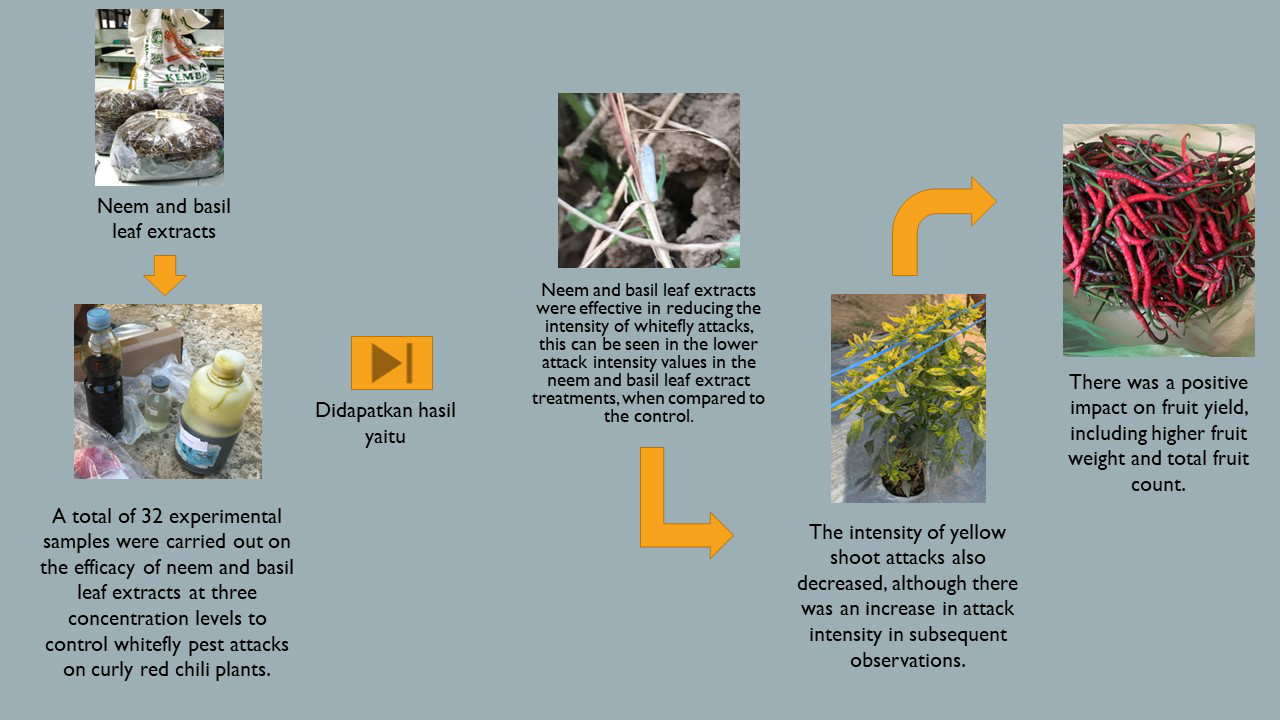
Whiteflies (Bemisia tabaci) are a major pest of curly red chili peppers, acting as vectors for gemini viruses that significantly reduce crop productivity. This study evaluated the efficacy of neem and basil leaf extracts at three different concentrations for controlling whitefly infestations on chili plants. A randomized complete block design (RCBD) was employed with 8 treatments and 2 controls: PA (Neem 1%), PB (Neem 2%), PC (Neem 3%), PD (Basil 1%), PE (Basil 2%), PF (Basil 3%), PKM (commercial pesticide as positive control), and P0 (distilled water as negative control). Parameters assessed included whitefly infestation intensity, yellowing of shoots, fruit weight, total fruit count, and the number of infested fruits. The results indicate that both neem and basil leaf extracts effectively reduced whitefly infestation intensity and yellowing of shoots compared to the negative control (P0). Despite some increase in infestation intensity in subsequent observations, both neem and basil extracts positively impacted fruit yield, including higher fruit weight and total fruit count. However, there was no significant effect on the number of infested fruits with the treatments. These findings suggest that neem and basil leaf extracts are promising alternatives for managing whitefly infestations and improving yield in curly red chili peppers.
References
Abadi, A. L. (2003). Ilmu penyakit tumbuhan (cetak 1). Malang: bayu media. https://onesearch.id/Record/IOS4679.JATIM000000000023890
Achmadi, S., Dwi, H., & Tatuk, T, S. (2020). The effect of bintaro (Cerbera manghas) leaf extract on transmission of aphids (Homoptera) in chili (Capsicum annuum) plants. International Journal of Biology and Biomedical Engineering, 14. https://doi.org/10.46300/91011.2020.14.31
Adelianingsih, D., Hidayati, R., & Sugiarto, Y. (2019). Potential of green leafhopper attack (empoasca sp.) in tea plantation based on climate change scenarios. Agromet, 33(2), 84–95. https://doi.org/10.29244/j.agromet.33.2.84-95
Agastya, I. M. I., Julianto, R. P. D., & Marwoto, M. (2020). Pengaruh pemanasan global terhadap intensitas serangan kutu kebul (Bemisia tabbaci genn.) dan cara pengendaliannya pada tanaman kedelai A Review. Buana Sains, 20(1), 99–110. https://doi.org/10.33366/bs.v20i1.1935
Arfiani, N., & Nasruddin, A. (2023). Control of pepper yellow leaf curl Indonesia virus and its vector (Bemisia tabaci Genn.) on chili plants (Capsicum annum L.) using resistant variety and insecticide application. IOP Conference Series: Earth and Environmental Science, 1230(1), 012119. https://doi.org/10.1088/1755-1315/1230/1/012119
Ariyanti, N. A. (2019). Seminar nasional VIII pendidikan biologi 197. Seminar Nasional VIII Pendidikan Biologi 15, (2011), 16–34. http://jurnal.fkip.uns.ac.id/index.php/prosbio/article/download/748/416
Barus, L., & Sutopo, A. (2019). Pemanfaatan ekstrak daun kemangi (Ocimum sanctum) sebagai repelan lalat rumah (Musca domestica). Jurnal Kesehatan, 10(3), 329. https://doi.org/10.26630/jk.v10i3.1270
Bashir, S., Yaqoob, A., Bashir, R., Bukhari, S., Shahid, N., Azam, S., Allah, B., Tayyab, H., Ali, S, A., & Rao, A. Q. (2024). Barley chitinase genes expression revamp resistance against whitefly (Bemisia Tabaci) in transgenic cotton (Gossypium hirsutum L.). Journal of Cotton Research, 7(1), 9. https://doi.org/10.1186/s42397-024-00169-y
Budi, G. P., Pribadi, T., Fitri, S. N., & Biky, M. A. (2023). The effectiveness of weed extract with different temperature aquades solvent for controlling antraknosa disease of red chili (Capsicum annum L.). IOP Conference Series: Earth and Environmental Science, 1183(1), 012093. https://doi.org/10.1088/1755-1315/1183/1/012093
Budiyani, N. K., & Sukasana, I. W. (2020). Pengendalian Serangan Hama Lalat Buah Pada Intensitas Kerusakan Buah Cabai Rawit (Capsicum frutescens L.) Dengan Bahan Petrogenol. Agrica, 13(1), 15–27. https://doi.org/10.37478/agr.v13i1.279
Direktorat Perlindungan Tanaman Pangan. (2018). Petunjuk teknis pengamatan dan pelaporan organisme penganggu tumbuhan dan dampak perubahan iklim (opt-dpi). https://tanamanpangan.pertanian.go.id/assets/front/uploads/document/JuknisDitlinrev2015.pdf
Fitrianti. (2020). Pengaruh Pemberian Ekstrak Daun Mimba Sebagai Pestisida Nabati Terhadap Hama Kutu Kebul Pada Tanaman Cabai Rawit (Capsicum frutescens L.). Program Studi Agroteknologi, Universitas Cokroaminoto Palopo, Skripsi. [Unpublished Skripsi].
Hapsoh., Gusmawartati., Amri, A. I., & Diansyah, A. (2017). Respons pertumbuhan dan produksi tanaman cabai keriting (Capsicum annuum L.) terhadap aplikasi pupuk K. ompos dan pupuk anorganik di polibag Jurnal Hortikultura Indonesia, 8(3), 203. https://doi.org/10.29244/jhi.8.3.203-208
Hasyim, A., Setiawati, W., & Liferdi. (2016). Kutu kebul bemisia tabaci gennadius (Hemiptera: aleyrodidae) penyebar penyakit virus mosaik kuning pada tanaman terung. Iptek Hortikultura, 12(2), 50–54. https://repository.pertanian.go.id/handle/123456789/6731
Hilman, Y., Rosliani, R., & Palupi, E. (2014). Pengaruh ketinggian tempat terhadap pembungaan, produksi, dan mutu benih botani bawang merah (the effect of altitude on flowering, production, and quality of true shallot seed). J. Hort., 24(2), 155. https://dx.doi.org/10.21082/jhort.v24n2.2014.p154-161
Ihsan, S. N., & Patandean, A. J. (2016). Analisis kelembaban udara dan temperatur permukaan dangkal dengan menggunakan hygrometer dan thermocouple di daerah pincara kecamatan masamba kabupaten Luwu Utara. Jurnal Sains Dan Pendidikan Fisika, 12(2), 204–208. https://dx.doi.org/10.35580/jspf.v12i2.2174
Karta, I. W., Dewi, A. A. L. N., Wati, N. L. C., & Dewi, N. M. A. (2017). Uji efektivitas larvasida daun mimba (Azadirachta indica) terhadap larva lalat sarcophaga pada daging untuk upakara yadnya di Bali. JST (Jurnal Sains Dan Teknologi), 6(1), 126–135. https://doi.org/10.23887/jstundiksha.v6i1.9233
Kurniawan, H. A., & Fitria. (2021). Neraca kehidupan kutu kebul (Bemisia tabaci genn.) (Hemiptera: aleyrodidae) pada tanaman cabai (capsicum annuum L.). Jurnal Agroteknologi Dan Perkebunan, 4(1), 22–26. https://media.neliti.com/media/publications/96169-ID-neraca-kehidupan-kutukebul-bemisia-tabac.pdf
Manikome, N. (2021). Application of plant insecticides basil leaves (Ocinum basilicum) for Plutella xylostella l. pest control on cabbage plants. Jurnal Agribisnis Perikanan, 14(2), 567–573. https://doi.org/10.52046/agrikan.v14i2.875
Manuputty, C., Patty, J. A., & Noya, S. H. (2023). Effectiveness some plant extracts of third instar nymphs nezara viridula l. (Hemiptera: pentatomidae) attack on string bean pod. Jurnal Agrosilvopasture-Tech, 2(1), 37–44. https://doi.org/10.30598/j.agrosilvopasture-tech.2023.2.1.37
Narendra, A. A. G. A., Phabiola, T. A., & Tuliadhi, K. A. (2017). Hubungan antara populasi kutu kebul (Bemisia tabaci) (Gennadius) (Hemiptera : aleyrodidae) dengan insiden penyakit kuning pada tanaman tomat (Solanum lycopersicum mill.) di Dusun Marga Tengah, Desa Kerta, Kecamatan Payangan, Bali. E-Jurnal Agroekoteknologi Tropika, 6(3), 339–348. https://jurnal.harianregional.com/jat/full-32443
Nuryani, S. (2019). Struktur daun cabai besar (Capsicum annum L. var. taro) pasca serangan kutu kebul (Bemisia tabaci Genn.) pada masa vegetatif. Program Studi Pendidikan Biologi, Universitas Islam Negeri Raden Intan Lampung, Skripsi. [Unpublished Skripsi].
Prasetya, M. E. (2014). Pengaruh pupuk NPK mutiara dan pupuk kandang sapi terhadap pertumbuhan dan hasil tanaman cabai merah keriting varietas arimbi (Capsicum annuum L.). Agrifor, XIII(2), 191–198. http://ejurnal.untag-smd.ac.id/index.php/AG/article/view/862
Purnama, I., Mutamima, A., Nelvia, N., Arini, A., Ihsan, F., & Yolanda, A. M. (2024). Pestisida dalam Sistem Pertanian Tropis Berkelanjutan. Soega Publishing: Bojonegoro.
Reza, N. S., Sulistyo, A., & Purnamaningsih, S. L. (2019). Identifikasi sifat ketahanan plasma nutfah kedelai (Glycine max L. merrill) terhadap kutu kebul (Bemisia tabaci genn.) identification of soybean germplasm (Glycine max L . merrill) for resistance to whitefly (Bemisia tabaci genn.). Journal of Agricultural Science, 4(1), 39–48. https://jpt.ub.ac.id/index.php/jpt/article/view/148/169
Safitri, S. (2015). El Nino, La Nina dan dampaknya terhadap kehidupan. Jurnal Criksetra, 4(8), 153. https://doi.org/10.36706/jc.v4i2.4786
Sagbo, I. J., Orock, A. E., Kola, E., & Otang-Mbeng, W. (2020). Phytochemical Screening and Gas Chromatography Mass Spectrometry Analysis of Ethanol Extract of Scambiosa columbabria L. Pharmacognosy research, 12(1). https://doi.org/10.4103/pr.pr_59_19
Singarimbun, M. A., Pinem, M. I., & Oemry, S. (2019). Hubungan antara populasi kutu kebul (bemisia tabacigenn.) dan kejadian penyakit kuning pada tanaman cabai (Capsicum annum L.). Angewandte Chemie International Edition, 6(11), 951–952., 2(4), 847–854. https://doi.org/10.32734/joa.v5i4.2499
Sirajuddin, Z., & Adriani, E. (2021). PKM penanggulangan hama kutu kebul pada cabai rawit menggunakan perangkap likat kuning di desa Ayuhula Kabupaten Gorontalo. Jurnal Pengabdi, 4(1), 93. https://doi.org/10.26418/jplp2km.v4i1.44798
Suhermanto, S., Rusmayadi, G., & Langai, B. F. (2021). The effect of temperature and relative humidity inside the shade netting on the growth of pepper fruiting branch cuttings. Tropical Wetland Journal, 7(2), 87–92. https://doi.org/10.20527/twj.v7i2.94
Suparman, S., Arsi, A., Pujiastuti, Y., & Pratama, R. (2024). The effects of some different cultural techniques on the transmission and infectious development of pepper yellow leaf curl indonesia virus on red chili. AGRIVITA Journal of Agricultural Science, 46(1), 15. https://doi.org/10.17503/agrivita.v46i1.4259
Supriyati, S., Tjahjono, B., & Effendy, S. (2018). Analisis pola hujan untuk mitigasi aliran lahar hujan gunungapi Sinabung. Jurnal Ilmu Tanah Dan Lingkungan, 20(2), 95–100. https://doi.org/10.29244/jitl.20.2.95-100
Taufik, M., Firihu, M. Z., HS, G., Variani, V. I., Hasan, A., Botek, M., Tihurua, E. F, & Wulansari, T. Y. I., (2024). The changes of chili leaf structure by geminivirus infection. Jurnal Hama Dan Penyakit Tumbuhan Tropika, 24(1), 109–119. https://doi.org/10.23960/jhptt.124109-119
Thaibah, M., Rosa, H. O., & Pramudi, M. I. (2021). Aplikasi pestisida nabati larutan kemangi terhadap hama penghisap daun cabai. Jurnal Proteksi Tanaman Tropika, 4(3), 407–412. https://doi.org/10.20527/jptt.v4i3.907
Tricahyati, T., Suparman, S., & Irsan, C. (2022). Insidensi dan intensitas serangan virus dan kaitannya dengan produksi cabai merah keriting yang diaplikasi berbagai warna mulsa. Agrikultura, 32(3), 248. https://doi.org/10.24198/agrikultura.v32i3.33768
Tuhuteru, S., Mahanani, A. U., & Rumbiak, R. E. Y. (2019). Pembuatan pestisida nabati untuk mengendalikan hama dan penyakit pada tanaman sayuran di distrik siepkosi kabupaten jayawijaya. Jurnal Pengabdian Kepada Masyarakat, 25(3), 135–143. https://jurnal.unimed.ac.id/2012/index.php/jpkm/article/view/14806/pdf
Xie, Y., Liu, X., Luo, C., Hu, Q., Che, X., Zhao, L., Zhao, M., Wu, L., & Ding, M. (2024). Distinct tomato yellow leaf curl chuxiong virus isolated from whiteflies and plants in China and its symptom determinant and suppressor of post-transcriptional gene silencing. Virology, 594, 110040. https://doi.org/10.1016/j.virol.2024.110040
Zaina, S., Wahyudi, N. I., Fahreza, M., Arifin, S., Ekawati, Ida, E., & Syabana, R. A., (2017). Keparahan serangan hama kutu kebul (bemisia tabaci) pada pertanaman cabai rawit (Capsicum frutuscens) di desa Matanair Kabupaten Sumenep. Snapp, 2588–2593. https://www.ejournalwiraraja.com/index.php/SNAPP/article/view/1744/1309