Phytoremediation of iron-contaminated soils using humic acid and hyperaccumulator grasses
DOI:
https://doi.org/10.31849/jip.v21i2.19890Keywords:
iron contamination, humic acid chelation, hyperaccumulator plants, Lapindo mud disaster, soil remediationAbstract
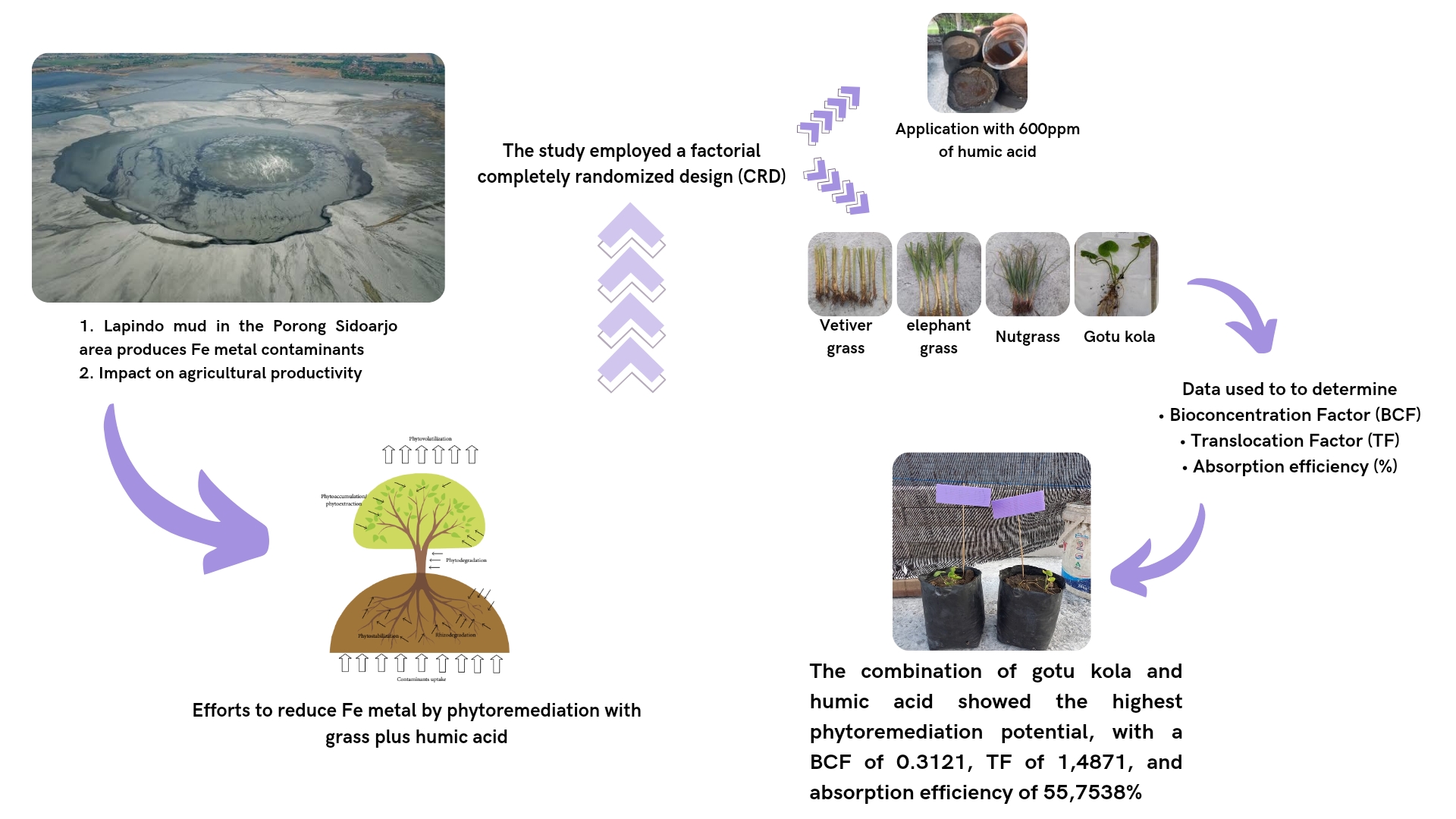
The Lapindo mud disaster in Porong, Sidoarjo, Indonesia, resulted from mining activities, leading to severe iron (Fe) contamination in the soil. This contamination has adversely impacted agricultural productivity in the affected areas. Phytoremediation, utilizing humic acid as a chelating agent and hyperaccumulator grasses, is a potential solution to mitigate this pollution. This study employed a factorial completely randomized design (CRD) to evaluate this approach with two factors: the application of 600 ppm humic acid and the use of different grasses (vetiver, elephant grass, nutgrass, and gotu kola). Observed parameters included plant dry weight and total iron content in soil and plant tissues. These data were used to determine the bioconcentration factor (BCF), translocation factor (TF), and absorption efficiency (%). The results indicated that humic acid significantly increased plant dry weight and iron uptake in plant tissues. The combination of gotu kola and humic acid showed the highest phytoremediation potential, with a BCF of 0.3121, TF of 1.4871, and an absorption efficiency of 55.7538%. This study highlights the effectiveness of humic acid and hyperaccumulator grasses in phytoremediation of iron-contaminated soils, offering a sustainable approach to improving soil health and agricultural productivity in polluted areas.
References
Ariyachandra, S. P., Alwis, I. S., & Wimalasiri, E. M. (2023). Phytoremediation potential of heavy metals by Cyperus rotundus. Reviews in Agricultural Science, 11(1), 20–35. https://doi.org/10.7831/ras.11.0_20
Armijn, A., & Soegianto, A. (2020). Perbandingan bioakumulasi logam berat melalui kontak lingkungan pada mangrove , crustacea (P . monodon), dan bivalvia (Anadara sp.) (studi kasus : paparan bahan pencemar lumpur lapindo). Paper Ekotoksikologi, 1–9. https://doi.org/10.13140/RG.2.2.27602.58565
Banerjee, R., Goswami, P., Lavania, S., Mukherjee, A., & Lavania, U. C. (2019). Vetiver grass is a potential candidate for phytoremediation of iron or mine spoil dumps. Ecological Engineering, 132, 120–136. https://doi.org/10.1016/j.ecoleng.2018.10.012
Bhat, I. U. H., Mauris, E. N., & Khanam, Z. (2016). Phytoremediation of iron from red soil of tropical region by using Centella asiatica. International Journal of Phytoremediation, 18(9), 918–923. https://doi.org/10.1080/15226514.2016.1156637
Bonor, Y. E. S., Wicaksono, K. S., & Utami, S. R. (2023). Pengaruh fitoremediasi tanaman lokal terhadap kadar timbal (pb) tanah di lahan penimbunan limbah pertambangan emas PT. antam. Jurnal Tanah dan Sumberdaya Lahan, 10(2), 509–514. https://doi.org/10.21776/ub.jtsl.2023.010.2.34
Cahyati, A., Arifin, S., & Abror, M. (2022). The potential of centong cactus (opuntia cochenillifera) as a remediation agent for sidoarjo mud polluted soil with indicators of fe content reduction and plant growth. Procedia of Engineering and Life Science, 2(2), 1–8. https://doi.org/10.21070/pels.v2i2.1269
Chandra, R., Kumar, V., Tripathi, S., & Sharma, P. (2018). Heavy metal phytoextraction potential of native weeds and grasses from endocrine-disrupting chemicals rich complex distillery sludge and their histological observations during in-situ phytoremediation. Ecological Engineering, 111, 143–156. https://doi.org/10.1016/j.ecoleng.2017.12.007
Chen, X. W., Wong, J. T. F., Wang, J. J., & Wong, M. H. (2021). Vetiver grass-microbe interactions for soil remediation. Critical Reviews in Environmental Science and Technology, 51(9), 897–938. https://doi.org/10.1080/10643389.2020.1738193
Coimbra, E. C. L., & Borges, A. C. (2023). Removing Mn, Cu and Fe from real wastewaters with macrophytes: reviewing the relationship between environmental factors and plants’ uptake capacity. Toxics, 11(2). https://doi.org/10.3390/toxics11020158
Dzakwan, M. A., & Ni’am, A. C. (2021). Kajian jenis tanaman rumput untuk teknologi fitoremediasi tanah tercemar logam berat. Seminar Teknologi Perencanaan, Perancangan, Lingkungan, Dan Infrastruktur II, 413–421. http://disbun.jabarprov.go.id/akarwangi,
Ferreira, A. D., Queiroz, H. M., Otero, X. L., Barcellos, D., Bernardino, Â. F., & Ferreira, T. O. (2022). Iron hazard in an impacted estuary: contrasting controls of plants and implications to phytoremediation. Journal of Hazardous Materials, 428, 128216. https://doi.org/10.1016/j.jhazmat.2022.128216
Grzegórska, A., Rybarczyk, P., Rogala, A., & Zabrocki, D. (2020). Phytoremediation-from environment cleaning to energy generation-current status and future perspectives. Energies, 13(11). https://doi.org/10.3390/en13112905
Handayani, W., & Winara, A. (2020). Diversity of soil macrofauna on several land use on peatlands. Jurnal Agroforestri Indonesia, 3(2), 77–88. https://doi.org/10.20886/jai.2020.3.2.77-88
Jahan-Nejati, S., Jowkar-Tangkarami, M., & Taei-Semiromi, J. (2021). Cyperus rotundus: a safe forage or hyper phytostabilizer species in copper contaminated soils. International Journal of Phytoremediation, 23(12), 1212–1221. https://doi.org/10.1080/15226514.2021.1888072
Komarawidjaja, W. (2017). Paparan limbah cair industri mengandung logam berat pada lahan sawah di Desa Jelegong, Kecamatan Rancaekek, Kabupaten Bandung. Jurnal Teknologi Lingkungan, 18(2), 173. https://doi.org/10.29122/jtl.v18i2.2047
Lestari, N. D., & Aji, A. N. (2020). Pengaruh kompos dan biochar terhadap fitoremediasi tanah tercemar kadmium dari lumpur lapindo menggunakan kangkung darat. Jurnal Tanah Dan Sumberdaya Lahan, 7(1), 167–176. https://doi.org/10.21776/ub.jtsl.2020.007.1.21
Maimunawaro, M., Rahman, S. K., & Irawan, C. (2021). Pemanfaatan asam humat dari sampah organik sebagai adsorben pada limbah cair sintesis timbal (Pb). Jurnal Teknik Kimia Indonesia, 19(1), 26. https://doi.org/10.5614/jtki.2020.19.1.5
Mauliana, M., & Suprayitno, A. (2017). Uji kelayakan kandungan unsur air tanah daerah terdampak lapindo kecamatan porong menggunakan XRF. Jurnal Inovasi Ilmu Pengetahuan, Teknologi Dan Seni (INOTEKS), 21(1), 154–162. https://doi.org/https://doi.org/10.21831/ino.v21i2.12984
Mazumdar, K., & Das, S. (2015). Phytoremediation of Pb, Zn, Fe, and Mg with 25 wetland plant species from a paper mill contaminated site in North East India. Environmental Science and Pollution Research, 22(1), 701–710. https://doi.org/10.1007/s11356-014-3377-7
Mazumdar, K., & Das, S. (2021). Multi-metal effluent removal by Centella asiatica (L) urban: prospects in phytoremediation. Environmental Technology and Innovation, 22, 101511. https://doi.org/10.1016/j.eti.2021.101511
Oksana, Taslapratama, I., Novia, Muhammad AliMahmud, Y., Septirosya, T., & Shofiah, R. (2024). Efektivitas biochar terhadap ketersediaan unsur hara mikro pada ultisol. Agroteknologi, 14(2), 81–88. https://doi.org/10.24014/ja.v14i2.26686
Ruhaimah, R., Asmar, A., & Harianti, M. (2009). Efek sisa asam humat dari kompos jerami padi dan pengelolaan air dalam mengurangi keracunan besi (Fe) tanah sawah bukaan baru terhadap produksi padi. Jurnal Solum, 6(1), 1–13. https://doi.org/10.25077/js.6.1.1-13.2009
Serdani, D. A., & Widiatmanta, J. (2019). Respon kandungan logam berat dan pertumbuhan tanaman sawi (Brassica juncea) terhadap kombinasi media tanam lumpur lapindo dan mikoriza. VIABEL: Jurnal Ilmiah Ilmu-Ilmu Pertanian, 13(2), 16–25. https://doi.org/10.35457/viabel.v13i2.837
Shah, V., & Daverey, A. (2020). Phytoremediation: a multidisciplinary approach to clean up heavy metal contaminated soil. Environmental Technology and Innovation, 18, 1–16. https://doi.org/10.1016/j.eti.2020.100774
Syarifdan, F., & Juhaeti, T. (2018). Potensi rumput - rumputan untuk fitoremediasi lahan terdegradasi penambangan emas. Berita Biologi, 6(6), 781–787. https://doi.org/10.14203/beritabiologi.v6i6.1206
Tanah, B. P. (2009). Petunjuk teknis analisis kimia tanah, tanaman, air, dan pupuk. Bogor : Balai penelitian dan pengembangan pertanian. https://doi.org/10.30965/9783657766277_011
Ulfindrayani, I. F., Fanani, N., A’yuni, Q., Ikhlas, N., Gaol, B. L., & Lestari, D. (2019). Pengaruh perbedaan preparasi lumpur lapindo terhadap kandungan senyawanya. E-Prosiding SNasTekS, 1(1), 235–240. https://doi.org/https://journal.unusida.ac.id/index.php/snts/article/view/93
Vimala, Y., Lavania, U. C., Banerjee, R., Lavania, S., & Mukherjee, A. (2022). Vetiver grass environmental model for rehabilitation of iron overburden soil: an ecosystem service approach. National Academy Science Letters, 45(2), 185–190. https://doi.org/10.1007/s40009-021-01087-2
Wang, X. qing, Lyu, T., Dong, R., Liu, H., & Wu, S. (2021). Dynamic evolution of humic acids during anaerobic digestion: exploring an effective auxiliary agent for heavy metal remediation. Bioresource Technology, 320, 1–10. https://doi.org/10.1016/j.biortech.2020.124331
Wang, Z., Jia, X., Sun, W., Wang, J., Li, C., Zhao, Q., Li, Y., & Tian, S. (2023). Persulfate-based remediation of organic-contaminated soil: insight into the impacts of natural iron ions and humic acids with complexation/redox functionality. Science of the Total Environment, 905, 167177. https://doi.org/10.1016/j.scitotenv.2023.167177
Wulan, S. N., Apriadi, T., & Melani, W. R. (2020). Studi fitoremediasi serapan besi (Fe) dari kolam bekas tambang bauksit menggunakan purun (Eleocharis sp.). Limnotek : Perairan Darat Tropis di Indonesia, 27(2), 67–78. https://doi.org/10.14203/limnotek.v27i2.270