In vitro efficacy of plant growth-promoting rhizobacteria isolated from ginger (Zingiber officinale) rhizosphere for biological control of plant pathogens
DOI:
https://doi.org/10.31849/jip.v21i3.23258Keywords:
in vitro antagonistic activity test, biological control, Fusarium oxysporum, Colletotrichum, AltenariaAbstract
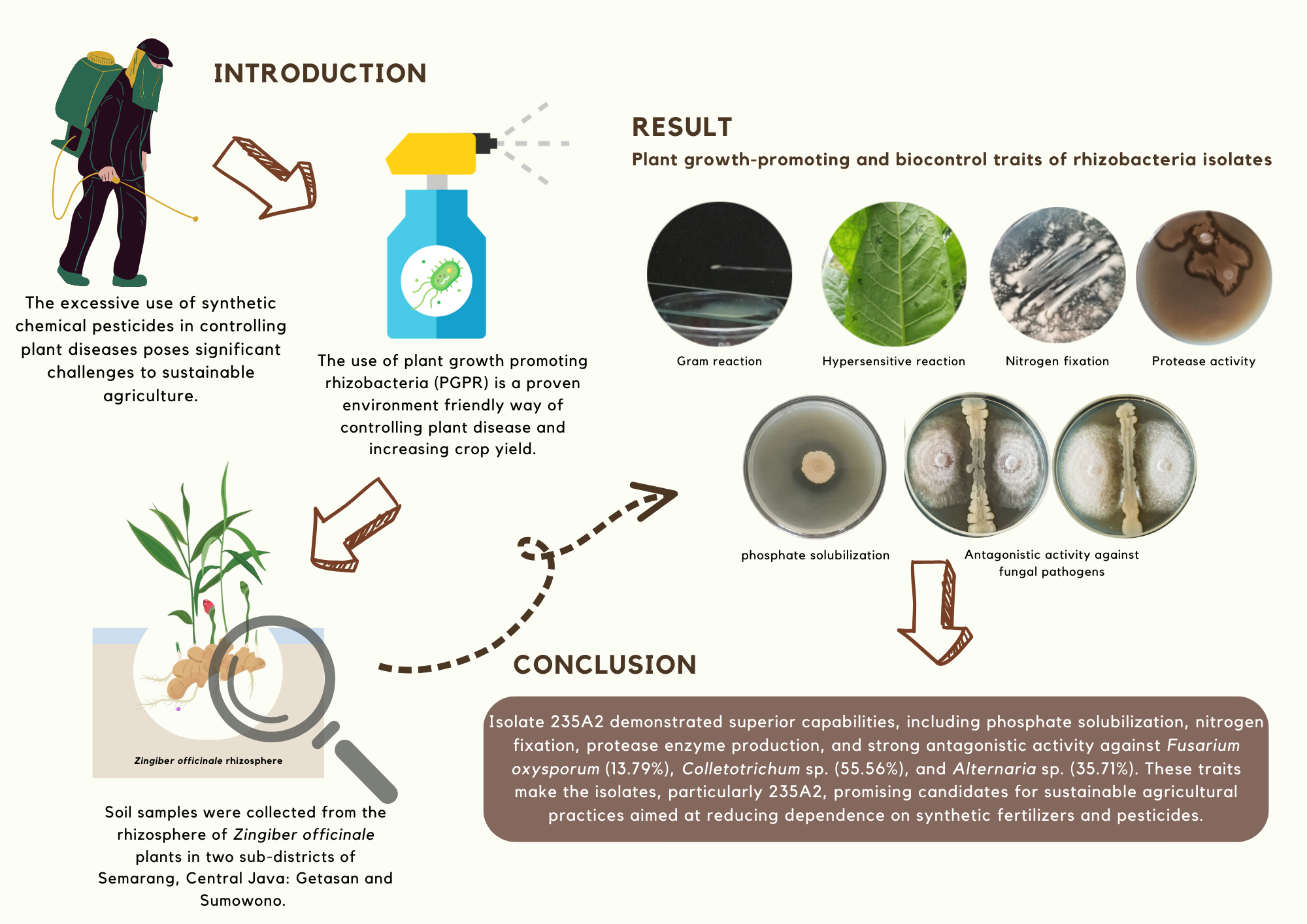
The excessive use of synthetic chemical pesticides in controlling plant diseases poses significant challenges to sustainable agriculture. As an environmentally friendly alternative, plant growth-promoting rhizobacteria (PGPR) have shown promise by colonizing plant roots and forming symbiotic relationships that enhance plant growth and suppress plant pathogens. Research on the isolation of PGPR from ginger (Zingiber officinale) rhizosphere in Indonesia remains limited, highlighting the need for further exploration to support genetic resource conservation and sustainable agricultural practices. This study aims to evaluate the potential of PGPR isolates from Z. officinale rhizosphere in Semarang, Indonesia, as biological control agents. Isolates were characterized based on morphology, biochemical traits, and their antagonistic activity against fungal pathogens, including Fusarium oxysporum, Colletotrichum sp., and Alternaria sp. A total of 14 isolates were obtained, exhibiting diverse morphological, biochemical, and antagonistic properties. Among them, isolate 235A2 demonstrated the highest potential as a biological control agent, with capabilities including phosphate solubilization, nitrogen fixation, protease enzyme production, and significant inhibition rates of F. oxysporum (13.79%), Colletotrichum sp. (55.56%), and Alternaria sp. (35.61%) in vitro. These findings underscore the potential of PGPR as a sustainable alternative for biological control of plant pathogens, supporting both enhanced plant productivity and environmental conservation.
References
Abdelaziz, A. A., Kamer, A. M. A., Al-Monofy, K. B., & Al-Madboly, L. A. (2023). Pseudomonas aeruginosa’s greenish-blue pigment pyocyanin: its production and biological activities. Microbial Cell Factories, 22(1), 110. https://doi.org/10.1186/s12934-023-02122-1
Admassie, M., Woldehawariat, Y., & Alemu, T. (2022). In vitro evaluation of extracellular enzyme activity and its biocontrol efficacy of bacterial isolates from pepper plants for the management of Phytophthora capsici. BioMed Research International, 2022, 1–13. https://doi.org/10.1155/2022/6778352
Balthazar, C., St-Onge, R., Léger, G., Lamarre, S. G., Joly, D. L., & Filion, M. (2022). Pyoluteorin and 2,4-diacetylphloroglucinol are major contributors to Pseudomonas protegens Pf-5 biocontrol against Botrytis cinerea in cannabis. Frontiers in Microbiology, 13. https://doi.org/10.3389/fmicb.2022.945498
Barillot, C. D. C., Sarde, C.-O., Bert, V., Tarnaud, E., & Cochet, N. (2013). A standardized method for the sampling of rhizosphere and rhizoplane soil bacteria associated to a herbaceous root system. Annals of Microbiology, 63(2), 471–476. https://doi.org/10.1007/s13213-012-0491-y
Bhai, R. S., Kishore, V. K., Kumar, a, Anandaraj, M., & Eapen, S. J. (2005). Screening of rhizobacterial isolates against soft rot disease of ginger (Zingiber officinale Rosc.). Journal of Spices and Aromatic Crops, 14(2), 130–136.
Bhattacharyya, C., Banerjee, S., Acharya, U., Mitra, A., Mallick, I., Haldar, A., Haldar, S., Ghosh, A., & Ghosh, A. (2020). Evaluation of plant growth promotion properties and induction of antioxidative defense mechanism by tea rhizobacteria of Darjeeling, India. Scientific Reports, 10(1), 15536. https://doi.org/10.1038/s41598-020-72439-z
Cassán, F., Perrig, D., Sgroy, V., Masciarelli, O., Penna, C., & Luna, V. (2009). Azospirillum brasilense Az39 and Bradyrhizobium japonicum E109, inoculated singly or in combination, promote seed germination and early seedling growth in corn (Zea mays L.) and soybean (Glycine max L.). European Journal of Soil Biology, 45(1), 28–35. https://doi.org/10.1016/j.ejsobi.2008.08.005
Chang, W.-T., Hsieh, C.-H., Hsieh, H.-S., & Chen, C. (2009). Conversion of crude chitosan to an anti-fungal protease by Bacillus cereus. World Journal of Microbiology and Biotechnology, 25(3), 375–382. https://doi.org/10.1007/s11274-008-9901-5
Chaudhary, P., Khati, P., Chaudhary, A., Gangola, S., Kumar, R., & Sharma, A. (2021). Bioinoculation using indigenous Bacillus spp. improves growth and yield of Zea mays under the influence of nanozeolite. 3 Biotech, 11(1), 11. https://doi.org/10.1007/s13205-020-02561-2
Chowdhury, S. P., Hartmann, A., Gao, X., & Borriss, R. (2015). Biocontrol mechanism by root-associated Bacillus amyloliquefaciens FZB42 – a review. Frontiers in Microbiology, 6. https://doi.org/10.3389/fmicb.2015.00780
Dewi, T. K., Arum, E. S., Imamuddin, H., & Antonius, S. (2015). Characterization of plant growth promoting rhizobacteria (PGPR) supporting organic biofertilizer. Prosiding Seminar Nasional Masyarakat Biodiversitas Indonesia, 1(2), 289–295. https://doi.org/10.13057/PSNMBI/M010220
Dikin, A., Sijam, K., Kadir, J., & Semanz, I. A. (2006). Antagonistic bacteria against Schizophyllum Commune FR. In Peninsular Malaysia. Biotropia, 13(2), 111–121. https://doi.org/10.11598/btb.2006.13.2.221
Dinesh, R., Anandaraj, M., Kumar, A., Bini, Y. K., Subila, K. P., & Aravind, R. (2015). Isolation, characterization, and evaluation of multi-trait plant growth promoting rhizobacteria for their growth promoting and disease suppressing effects on ginger. Microbiological Research, 173, 34–43. https://doi.org/10.1016/J.MICRES.2015.01.014
El-Sayed, W. S., Akhkha, A., El-Naggar, M. Y., & Elbadry, M. (2014). In vitro antagonistic activity, plant growth promoting traits and phylogenetic affiliation of rhizobacteria associated with wild plants grown in arid soil. Frontiers in Microbiology, 5. https://doi.org/10.3389/fmicb.2014.00651
Gupta, S., & Pandey, S. (2023). Plant Growth Promoting Rhizobacteria to Mitigate Biotic and Abiotic Stress in Plants (pp. 47–68). https://doi.org/10.1007/978-3-031-24181-9_3
Hartman, K., & Tringe, S. G. (2019). Interactions between plants and soil shaping the root microbiome under abiotic stress. Biochemical Journal, 476(19), 2705–2724. https://doi.org/10.1042/BCJ20180615
Hu, H., Gao, Y., Li, X., Chen, S., Yan, S., & Tian, X. (2020). Identification and nematicidal characterization of proteases secreted by endophytic Bacteria Bacillus cereus BCM2. Phytopathology®, 110(2), 336–344. https://doi.org/10.1094/PHYTO-05-19-0164-R
Jangir, M., Pathak, R., Sharma, S., & Sharma, S. (2018). Biocontrol mechanisms of Bacillus sp., isolated from tomato rhizosphere, against Fusarium oxysporum f. sp. lycopersici. Biological Control, 123, 60–70. https://doi.org/10.1016/j.biocontrol.2018.04.018
Jasim, B., Joseph, A. A., John, C. J., Mathew, J., & Radhakrishnan, E. K. (2014). Isolation and characterization of plant growth promoting endophytic bacteria from the rhizome of Zingiber officinale. 3 Biotech, 4(2), 197–204. https://doi.org/10.1007/S13205-013-0143-3/FIGURES/2
Kazerooni, E. A., Maharachchikumbura, S. S. N., Al-Sadi, A. M., Kang, S.-M., Yun, B.-W., & Lee, I.-J. (2021). Biocontrol potential of Bacillus amyloliquefaciens against Botrytis pelargonii and Alternaria alternata on Capsicum annuum. Journal of Fungi, 7(6), 472. https://doi.org/10.3390/jof7060472
Khalil, M. S. M., Hassan, M. H. A. R., Mahmoud, A. F., & Morsy, K. M. M. (2022). Involvement of secondary metabolites and extracellular lytic enzymes produced by plant growth promoting rhizobacteria in inhibiting the soilborne pathogens in Faba Bean Plants. Jurnal Hama Dan Penyakit Tumbuhan Tropika, 22(2), 100–108. https://doi.org/10.23960/JHPTT.222100-108
Klement, Z., & Goodman, R. N. (1967). The hypersensitive reaction to infection by bacterial plant pathogens. Annual Review of Phytopathology, 5(1), 17–44. https://doi.org/10.1146/annurev.py.05.090167.000313
Kour, D., Kaur, T., Devi, R., Chaubey, K. K., & Yadav, A. N. (2023). Co-inoculation of nitrogen fixing and potassium solubilizing Acinetobacter sp. for growth promotion of onion (Allium cepa). Biologia, 78(9), 2635–2641. https://doi.org/10.1007/s11756-023-01412-8
Li, B., Meng, X., Shan, L., & He, P. (2016). Transcriptional regulation of pattern-triggered immunity in plants. Cell Host & Microbe, 19(5), 641–650. https://doi.org/10.1016/j.chom.2016.04.011
Lucas, J. A. (2011). Advances in plant disease and pest management. The Journal of Agricultural Science, 149(S1), 91–114. https://doi.org/10.1017/S0021859610000997
Maghrawy, H., Gomaa, O., Abd El Kareem, H., Refae, R., & ElGizawy, S. (2020). Biocontrol mechanisms of Bacillus sp. and its application as a bionanocomposite against Rhizoctonia solani. Journal of Nuclear Technology in Applied Science, 49–65. https://doi.org/10.21608/jntas.2020.25368.1020
Marwan, H., Hayati, I., & Mulyati, S. (2023). Effectiveness of biofungicide formula on rhizome rot disease of red ginger and its plant growth. Biodiversitas Journal of Biological Diversity, 24(4). https://doi.org/10.13057/biodiv/d240425
Maya K.C, B., Prasad Gauchan, D., Khanal, S. N., & Lamichhane, J. (2022). Isolation and characterization of plant growth promoting rhizobacteria from bamboo rhizosphere and their role in plant growth promotion. Nepal Journal of Science and Technology, 21(1), 1–12. https://doi.org/10.3126/njst.v21i1.49908
Mudili, J. (2007). Introductory Practical Microbiology. New Delhi: Narosa Publishing House.
Onwona‐kwakye, M., Plants‐paris, K., Keita, K., Lee, J., Brink, P. J. V. den, Hogarh, J. N., & Darkoh, C. (2020). Pesticides decrease bacterial diversity and abundance of irrigated rice fields. Microorganism, 8(3), 318. https://doi.org/10.3390/MICROORGANISMS8030318
Prihatiningsih, N., Asnani, A., & Djatmiko H. A. (2021). Extracellular protease from Bacillus subtilis B315 with antagonistic activity against bacterial wilt pathogen (Ralstonia solanacearum) of chili. Biodiversitas Journal of Biological Diversity, 22(3). https://doi.org/10.13057/biodiv/d220327
Prodhan, Md. Y., Rahman, Md. B., Rahman, A., Akbor, Md. A., Ghosh, S., Nahar, Mst. N.-E.-N., Simo, Shamsuzzoha, Md., Cho, K. M., & Haque, Md. A. (2023). Characterization of growth-promoting activities of consortia of chlorpyrifos mineralizing endophytic bacteria naturally harboring in rice plants—a potential bio-stimulant to develop a safe and sustainable agriculture. Microorganisms, 11(7), 1821. https://doi.org/10.3390/microorganisms11071821
Purnama, I., M Malhat, F., Mutamima, A., Ihsan, F., & Amalia, A. (2023). A comparative study on pesticide residue profiles in locally grown rice from conventional and sustainable agricultural methods. Jurnal Ilmiah Pertanian, 20(3), 219-231. https://doi.org/10.31849/jip.v20i3.17122
Rawat, P., Shankhdhar, D., & Shankhdhar, S. C. (2020). Plant Growth-Promoting Rh.,izobacteria: A Booster for Ameliorating Soil Health and Agriculture Production (pp. 47–68). https://doi.org/10.1007/978-3-030-44364-1_3
Rizzo, D. M., Lichtveld, M., Mazet, J. A. K., Togami, E., & Miller, S. A. (2021). Plant health and its effects on food safety and security in a One Health framework: four case studies. One Health Outlook 2021 3:1, 3(1), 1–9. https://doi.org/10.1186/S42522-021-00038-7
Rodríguez-Sahagún, A., Velasco-Jiménez, A., Castellanos-Hernández, O., Acevedo-Hernández, G., & Clarenc Aarland, R. (2020). Bacterias rizosféricas con beneficios potenciales en la agricultura. Frontiers in Microbiology, 38(2), 333–345. https://doi.org/10.28940/terra.v38i2.470
Santosa, S., Sutarno, Purwanto, E. D. I., Suranto, & Sajidan. (2018). Molecular characterization of plant growth promoting rhizobacteria using 16S rRNA sequences in the organic rice field of Sukorejo Village, Central Java, Indonesia. Biodiversitas Journal of Biological Diversity, 19(6), 2157–2162. https://doi.org/10.13057/BIODIV/D190623
Sari, I. J., Wahyuni, I., Khastini, R. O., Awaliyati, E., Susilowati, A., Utari, E., & Aryantha, I. N. P. (2021). Characterization of plant growth promoting rhizobacteria (PGPR) on Capcissum annum. Jurnal Biodjati, 6(2), 255–263. https://doi.org/10.15575/BIODJATI.V6I2.13191
Savary, S., Willocquet, L., Pethybridge, S. J., Esker, P., McRoberts, N., & Nelson, A. (2019). The global burden of pathogens and pests on major food crops. Nature Ecology & Evolution 2019 3:3, 3(3), 430–439. https://doi.org/10.1038/s41559-018-0793-y
Sayyed, R. Z. (Ed.). (2019). Plant Growth Promoting Rhizobacteria for Sustainable Stress Management (Vol. 13). Springer Singapore. https://doi.org/10.1007/978-981-13-6986-5
Schaad, N. W., Jones, J. B., & Chun, W. (2001). Laboratory Guide for Identification of Plant Pathogenic Bacteria, Third Edition. Plant Pathology, 50(6), 812–814. https://doi.org/10.1046/j.1365-3059.2001.00635.x
Solanki, P., Putatunda, C., Kumar, A., Bhatia, R., & Walia, A. (2021). Microbial proteases: ubiquitous enzymes with innumerable uses. 3 Biotech, 11(10), 428. https://doi.org/10.1007/s13205-021-02928-z
Viaene, T., Langendries, S., Beirinckx, S., Maes, M., & Goormachtig, S. (2016). Streptomyces as a plant’s best friend? FEMS Microbiology Ecology, 92(8), fiw119. https://doi.org/10.1093/femsec/fiw119
Walder, F., Schmid, M. W., Riedo, J., Valzano-Held, A. Y., Banerjee, S., Büchi, L., Bucheli, T. D., & van der Heijden, M. G. A. (2022). Soil microbiome signatures are associated with pesticide residues in arable landscapes. Soil Biology and Biochemistry, 174, 108830. https://doi.org/10.1016/J.SOILBIO.2022.108830
Yu, H., Wu, X., Zhang, G., Zhou, F., Harvey, P. R., Wang, L., Fan, S., Xie, X., Li, F., Zhou, H., Zhao, X., & Zhang, X. (2022). Identification of the phosphorus-solubilizing bacteria strain JP233 and its effects on soil phosphorus leaching loss and crop growth. Frontiers in Microbiology, 13. https://doi.org/10.3389/fmicb.2022.892533