Phytoremediation potential of Avicennia marina, Rhizophora mucronata, and Bruguiera gymnorrhiza in lead (Pb) contaminated urban coastal areas
DOI:
https://doi.org/10.31849/jip.v22i1.24112Keywords:
phytoremediation, heavy metal, lead contamination, mangrove forests, urban coastal areasAbstract
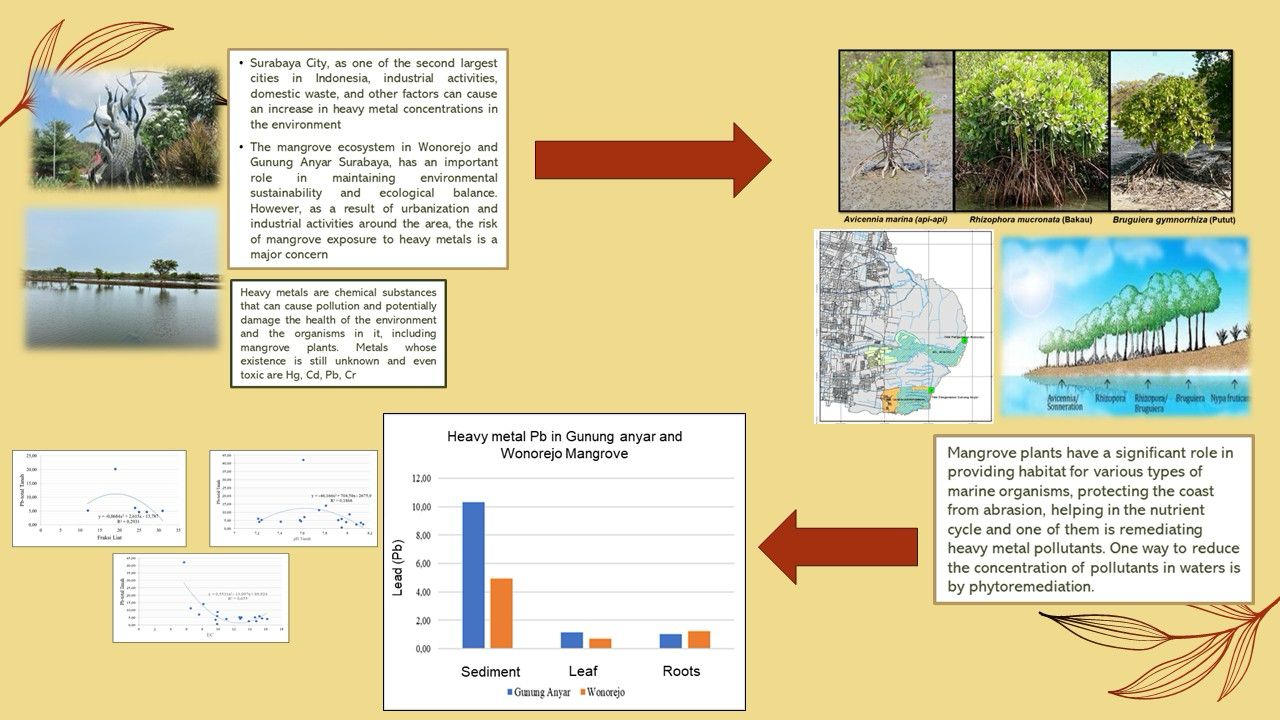
Heavy metal contamination in urban coastal areas poses a serious environmental threat, with lead (Pb) being one of the most persistent and hazardous pollutants. Mangrove forests, which act as natural buffers between land and sea, have the potential to mitigate heavy metal pollution through phytoremediation. This study evaluates the phytoremediation potential of three mangrove species—Avicennia marina, Rhizophora mucronata, and Bruguiera gymnorrhiza—in lead-contaminated coastal areas of Wonorejo and Gunung Anyar, Surabaya, Indonesia. Sediment, root, and leaf samples were collected using a survey method and purposive random sampling. Physiochemical analysis included soil texture, pH, electrical conductivity (EC), and Pb concentration. Pb levels in Gunung Anyar sediments reached 12.0 ppm, higher than Wonorejo’s 4.05 ppm. A. marina exhibited the highest Pb accumulation, with a bioconcentration factor (BCF) of 8.85 in roots and 6.97 in leaves. R. mucronata had a BCF of 5.75 in roots and 2.09 in leaves, while B. gymnorrhiza demonstrated a root BCF of 28.8 and leaf BCF of 28.4. Translocation factor (TF) analysis revealed that A. marina had the highest TF (1.27), indicating phytostabilization as its primary mechanism. Meanwhile, R. mucronata and B. gymnorrhiza exhibited phytoextraction characteristics due to higher metal translocation efficiency. These findings highlight the distinct phytoremediation strategies among species.
References
Adimalla, N., Chen, J., & Qian, H. (2020). Spatial characteristics of heavy metal contamination and potential human health risk assessment of urban soils: A case study from an urban region of South India. Ecotoxicology and Environmental Safety, 194, 110406. https://doi.org/10.1016/j.ecoenv.2020.110406
Aditya, H. F., & Wijayanti, F. (2023). Mengenal Karakteristik dan Jenis Tanah-Tanah Pertanian di Indonesia-Jejak Pustaka. Jejak Pustaka.
Agbangba, C. E., Aide, E. S., Honfo, H., & Kakai, R. G. (2024). On the use of post-hoc tests in environmental and biological sciences: A critical review. Heliyon, 10(3). https://doi.org/10.1016/j.heliyon.2024.e25131
Chaikaew, P., & Chavanich, S. (2017). Spatial variability and relationship of mangrove soil organic matter to organic carbon. Applied and Environmental Soil Science, 2017(1), 4010381. https://doi.org/10.6088/ijes.2013030600045
Dajam, A. S., Keshta, A. E., Bindajam, A. A., & Eid, E. M. (2024). Bioaccumulation of Heavy Metals in Mangrove (Avicennia marina): Predictive Uptake Modeling and Phytoremediation Potential. Journal of Soil Science and Plant Nutrition, 24(3), 6085–6098. https://doi.org/10.1007/s42729-024-01962-z
Dewiyanti, I., Darmawi, D., Muchlisin, Z., Helmi, T., Imelda, I., & Defira, C. (2021). Physical and chemical characteristics of soil in mangrove ecosystem based on differences habitat in Banda Aceh and Aceh Besar. 674(1), 012092. https://doi.org/10.1088/1755-1315/674/1/012092
Doelle, M., & Puthucherril, T. G. (2023). Nature‐based solutions to sea level rise and other climate change impacts on oceanic and coastal environments: A law and policy perspective. Nordic Journal of Botany, 2023(1), https://doi.org/10.1111/njb.03051
Dookie, S., Jaikishun, S., & Ansari, A. A. (2024). Soil and water relations in mangrove ecosystems in Guyana. Geology, Ecology, and Landscapes, 8(3), 445–469. https://doi.org/10.1080/24749508.2022.2142186
dos Santos Garcia, J., Sershen, & França, M. G. C. (2021). Mangrove Assisted Remediation and Ecosystem Services. Handbook of Assisted and Amendment: Enhanced Sustainable Remediation Technology, 535–556.
Drewry, J. J., Cavanagh, J.-A. E., McNeill, S. J., Stevenson, B. A., Gordon, D. A., & Taylor, M. D. (2021). Long-term monitoring of soil quality and trace elements to evaluate land use effects and temporal change in the Wellington region, New Zealand. Geoderma Regional, 25, e00383. https://doi.org/10.1016/j.geodrs.2021.e00383
El-Sharkawy, M., Alotaibi, M. O., Li, J., Du, D., & Mahmoud, E. (2025). Heavy Metal Pollution in Coastal Environments: Ecological Implications and Management Strategies: A Review. Sustainability, 17(2), 701. https://doi.org/10.3390/su17020701
Fajrin, F. M., Muskananfola, M. R., & Hendrarto, B. (2016). Karakteristik Abrasi dan Pengaruhnya terhadap Masyarakat di Pesisir Semarang Barat. Management of Aquatic Resources Journal (MAQUARES), 5(2), 43–50. https://doi.org/10.14710/marj.v5i2.11645
Ganeshkumar, A., Arun, G., Vinothkumar, S., & Rajaram, R. (2019). Bioaccumulation and translocation efficacy of heavy metals by Rhizophora mucronata from tropical mangrove ecosystem, Southeast coast of India. Ecohydrology & Hydrobiology, 19(1), 66–74. https://doi.org/10.1016/j.ecohyd.2018.10.006
Garbisu, C., & Alkorta, I. (2001). Phytoextraction: A cost-effective plant-based technology for the removal of metals from the environment. Bioresource Technology, 77(3), 229–236. https://doi.org/10.1016/S0960-8524(00)00108-5
Ghasemi, S., Siavash Moghaddam, S., Rahimi, A., Damalas, C. A., & Naji, A. (2018). Phytomanagement of trace metals in mangrove sediments of Hormozgan, Iran, using gray mangrove (Avicennia marina). Environmental Science and Pollution Research, 25, 28195–28205. https://doi.org/10.1007/s11356-018-2684-9
Hidayah, Z., & Rachman, H. A. (2023). Pemetaan kondisi hutan mangrove di kawasan pesisir Selat Madura dengan pendekatan Mangrove Health Index memanfaatkan citra satelit Sentinel-2. Majalah Geografi Indonesia, 37(1), 84–91. https://doi.org/10.22146/mgi.78136
Hossain, M. B., Masum, Z., Rahman, M. S., Yu, J., Noman, M. A., Jolly, Y. N., Begum, B. A., Paray, B. A., & Arai, T. (2022). Heavy metal accumulation and phytoremediation potentiality of some selected mangrove species from the world’s largest mangrove forest. Biology, 11(8), 1144. https://doi.org/10.3390/biology11081144
Hu, B., Guo, P., Wu, Y., Deng, J., Su, H., Li, Y., & Nan, Y. (2021). Study of soil physicochemical properties and heavy metals of a mangrove restoration wetland. Journal of Cleaner Production, 291, 125965. https://doi.org/10.1016/j.jclepro.2021.125965
Hurum, P. H., Fauzi, T., & Sudharmawan, A. K. (2023). Soil Properties Affecting Mercury (Hg) Adsorption-Desorption: Determine The Extent of Soil Pollution Risk. Jurnal Biologi Tropis, 23(2), 311–321. DOI: 10.29303/jbt.v23i2.6157
Ji, R., Li, C., Luo, J., Gao, Y., Li, S., Wang, X., Tian, L., Chen, X., & Yao, D. (2025). Bioavailability of Heavy Metals in Soils from a City with Fe-Nb-REE Mineral Development. https://doi.org/10.21203/rs.3.rs-5873762/v1
Khotimah, N. N., Putri, W. A. E., Aryawati, R., & Nugroho, R. Y. (2024). Bioaccumulation and Ecological Risk Assessment of Heavy Metal Contamination (Lead and Copper) Build Up in the Roots of Avicennia alba and Excoecaria agallocha. Journal of Ecological Engineering, 25(5). https://doi.org/10.12911/22998993/185716
Li, W., Zuo, Y., Li, Y., Ning, D., Zhang, H., Xia, C., Zhang, X., & Deng, H. (2025). Assessment of Soil Heavy Metal Pollution and Phytoremediation Potential of Dominant Species in Water-Level-Fluctuation Zone of Large Reservoir. Land, 14(1), 90. https://doi.org/10.3390/land14010090
Lian, M., Wang, J., Ma, Y., Li, J., & Zeng, X. (2022). Influence of DOM and its subfractions on the mobilization of heavy metals in rhizosphere soil solution. Scientific Reports, 12(1), 14082. https://doi.org/10.1038/s41598-022-18419-x
Lincoln, S., Andrews, B., Birchenough, S. N., Chowdhury, P., Engelhard, G. H., Harrod, O., Pinnegar, J. K., & Townhill, B. L. (2022). Marine litter and climate change: Inextricably connected threats to the world’s oceans. Science of The Total Environment, 837, https://doi.org/10.1016/j.scitotenv.2022.155709
Manikasari, G. P., & Mahayani, N. P. D. (2018). Peran hutan mangrove sebagai biofilter dalam pengendalian polutan Pb dan Cu di hutan mangrove Sungai Donan, Cilacap, Jawa Tengah. Jurnal Nasional Teknologi Terapan, 2(2), 105–117. https://doi.org/10.22146/jntt.42721
Meng, W., Wang, Z., Hu, B., Wang, Z., Li, H., & Goodman, R. C. (2016). Heavy metals in soil and plants after long-term sewage irrigation at Tianjin China: A case study assessment. Agricultural Water Management, 171, 153–161. https://doi.org/10.1016/j.agwat.2016.03.013
Mentari, R. J., Soenardjo, N., & Yulianto, B. (2022). Potensi fitoremediasi mangrove Rhizophora mucronata terhadap logam berat tembaga di Kawasan Mangrove Park, Pekalongan. Journal of Marine Research, 11(2), 183–188. https://doi.org/10.14710/jmr.v11i2.33246
Nichols, C. R., Zinnert, J., & Young, D. R. (2019). Degradation of coastal ecosystems: Causes, impacts and mitigation efforts. Tomorrow’s Coasts: Complex and Impermanent, 119–136. https://doi.org/10.1007/978-3-319-75453-6_8
Phaenark, C., Phankamolsil, Y., & Sawangproh, W. (2024). Ecological and health implications of heavy metal bioaccumulation in Thai Fauna: A systematic review. Ecotoxicology and Environmental Safety, 285, 117086. https://doi.org/10.1016/j.ecoenv.2024.117086
Rahman, S. U., Han, J.-C., Zhou, Y., Ahmad, M., Li, B., Wang, Y., Huang, Y., Yasin, G., Ansari, M. J., & Saeed, M. (2024). Adaptation and remediation strategies of mangroves against heavy metal contamination in global coastal ecosystems: A review. Journal of Cleaner Production, 140868. https://doi.org/10.1016/j.jclepro.2024.140868
Sarath, N. G., & Puthur, J. T. (2021). Heavy metal pollution assessment in a mangrove ecosystem scheduled as a community reserve. Wetlands Ecology and Management, 29(5), 719–730. https://doi.org/10.1007/s11273-020-09764-7
Setyaningrum, E. W., Dewi, A. T. K., Yuniartik, M., & Masithah, E. D. (2018). Analisis kandungan logam berat Cu, Pb, Hg dan Sn terlarut di pesisir Kabupaten Banyuwangi. 144–153.
Usman, A. R., Alkredaa, R. S., & Al-Wabel, M. (2013). Heavy metal contamination in sediments and mangroves from the coast of Red Sea: Avicennia marina as potential metal bioaccumulator. Ecotoxicology and Environmental Safety, 97, 263–270.
Wang, Q., Wen, Y., Zhao, B., Hong, H., Liao, R., Li, J., Liu, J., Lu, H., & Yan, C. (2021). Coastal soil texture controls soil organic carbon distribution and storage of mangroves in China. Catena, 207, 105709. https://doi.org/10.1016/j.catena.2021.105709
Wu, Y., Li, X., Yu, L., Wang, T., Wang, J., & Liu, T. (2022). Review of soil heavy metal pollution in China: Spatial distribution, primary sources, and remediation alternatives. Resources, Conservation and Recycling, 181, 106261. https://doi.org/10.1016/j.resconrec.2022.106261
Yap, C. K., & Al-Mutairi, K. A. (2023). Potentially toxic metals in the tropical mangrove non-salt secreting Rhizophora apiculata: A field-based biomonitoring study and phytoremediation potentials. Forests, 14(2), 237. https://doi.org/10.3390/f14020237