Agronomic performance and sugar yield potential of seven promising sugarcane (Saccharum officinarum L.) clones in second ratoon cultivation
DOI:
https://doi.org/10.31849/jip.v22i1.25150Keywords:
sugarcane, ratoon, agronomic performance, yield potential, superior clonesAbstract
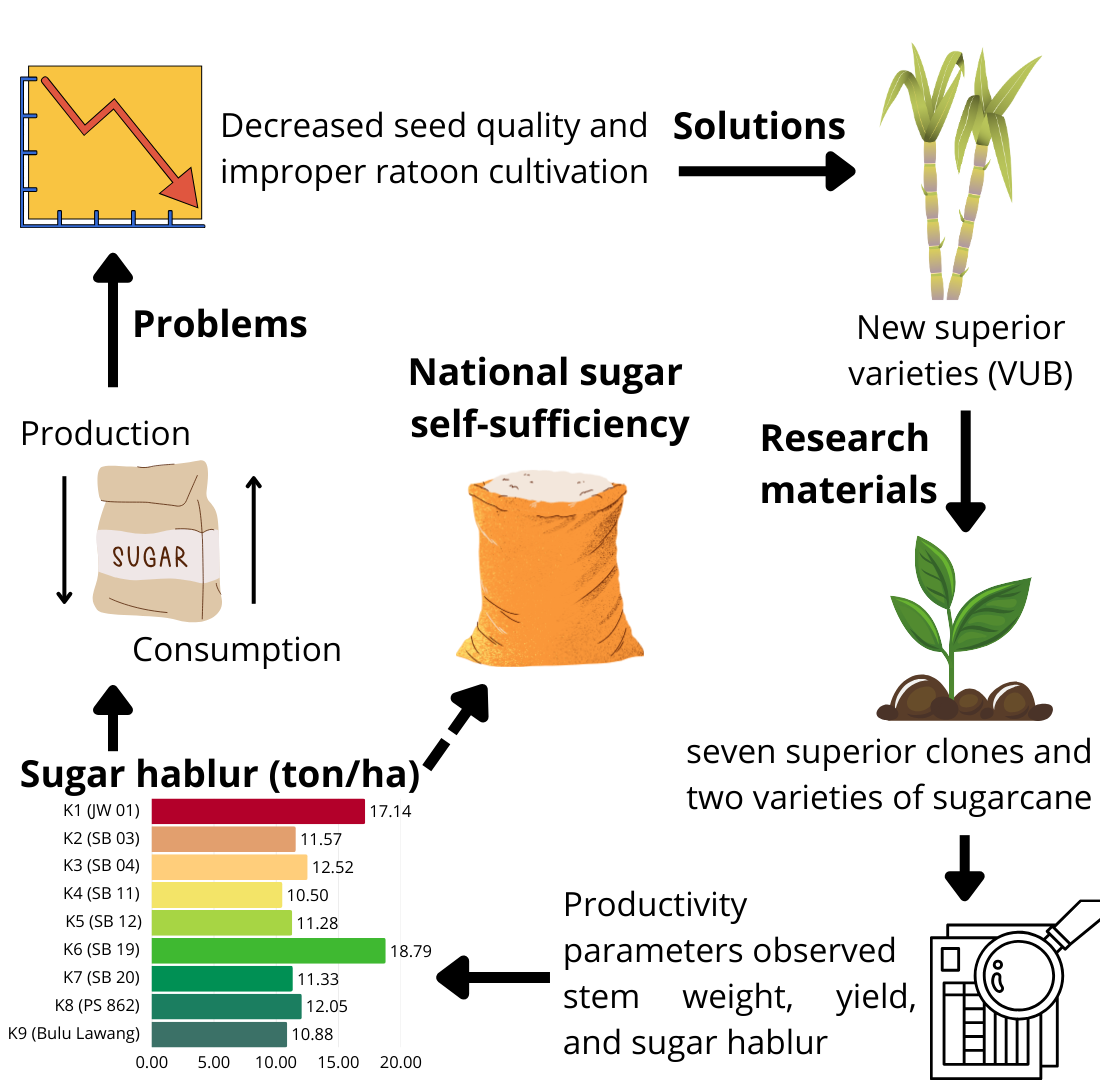
The decline in sugarcane productivity and the imbalance between sugar production and national consumption are largely attributed to the genetic degradation of long-cultivated commercial varieties and suboptimal ratoon management. This study evaluates the agronomic performance and sugar yield potential of seven promising sugarcane (Saccharum officinarum L.) clones in their second ratoon cycle. The research was conducted at the Sugarcane Research and Development Center (P3T) in collaboration with PG Krembung, PT Perkebunan Nusantara X (PTPN X), in Watesari Village, Sidoarjo, Indonesia. A randomized complete block design (RCBD) with one factor and nine treatments was employed. Statistical analysis comprised ANOVA at a 5% significance level, Least Significant Difference (LSD) test, genetic diversity analysis, and heritability estimation. The results revealed significant differences among the clones in stalk diameter, brix, stalk weight, yield, and sugar content. The JW01 UMG NX clone exhibited the highest stalk diameter (33.31 mm) and sugar recovery (11.64%), while the SB19 UMG NX clone demonstrated the highest stalk weight (165.28 tons/ha), brix (23.78 °Bx), and yield (18.79 tons/ha). Genetic diversity was low across all measured traits, but heritability values were high, suggesting a strong genetic influence. These findings indicate that JW01 UMG NX and SB19 UMG NX are highly productive and hold strong potential as candidates for new superior varieties (VUB) to support national sugar self-sufficiency.
References
Abu-Ellail, F. F. B., El-Azez, Y. M. A., & Bassiony, N. A. (2019). Assessment of ratooning ability and genetic variability of promising sugarcane varieties under middle Egypt conditions. Electronic Journal of Plant Breeding, 10(1), 143–154. https://doi.org/10.5958/0975-928X.2019.00017.6
Acreche, M. M., Saez, J. V., & Chalco Vera, J. (2015). Physiological bases of genetic gains in sugarcane yield in Argentina. Field Crops Research, 175, 80–86. https://doi.org/10.1016/j.fcr.2015.02.002
Amal, F. I., Sihmawati, R. R., Wulandari, A., & Wardah, W. (2023). Pengaruh umur simpan tebu terhadap kualitas nira tebu (Saccaharum officinarum L.). Heuristic, 209–2014. https://doi.org/10.30996/heuristic.v20i2.10159
Andeva, N., Indrawati, W., & Kusumastuti, A. (2018). Produktivitas tebu (Saccharum officinarum L.) asal bibit bud chips (ujung, tengah, pangkal) akibat aplikasi mulsa bagasse. Jurnal Agro Industri Perkebunan, 6(2), 99. https://doi.org/10.25181/jaip.v6i2.815
Antika, L., & Ingesti, P. S. V. R. (2020). Analisis lama waktu pangkal batang tebu (Saccharum officinarum L.) tertinggal di lahan terhadap nilai rendemen. Vigor: Jurnal Ilmu Pertanian Tropika Dan Subtropika, 5(1), 19–23. https://doi.org/10.31002/vigor.v5i1.2414
Apriliyanto, H., Budi, S., & Nur Lailiyah, W. (2024). Keragaan pertumbuhan dan produktivitas keprasan ii beberapa klon unggul tebu (Saccharum officinarum L.) di lahan kering Juwet Mojoagung Jombang. TROPICROPS (Indonesian Journal of Tropical Crops), 7(2), 108. https://doi.org/10.30587/tropicrops.v7i2.8409
Bashir, S., Fiaz, N., Ghaffar, A., & Khalid, F. (2012). Ratooning ability of sugarcane genotypes at different harvesting dates. International Sugar Journal, 114(1360), 273–276. https://www.researchgate.net/publication/258926437_Ratooning_ability_of_sugarcane_genotypes_at_different_harvesting_dates
Begna, T. (2020). Major Challenging constraints to crop production farming system and possible breeding to overcome the constraints. International Journal of Research Studies in Agricultural Sciences, 6(7), 27–46. https://doi.org/10.20431/2454-6224.0607005
Bhandari, U., Gajurel, A., Khadka, B., Thapa, I., Chand, I., Bhatta, D., Poudel, A., Pandey, M., Shrestha, S., & Shrestha, J. (2023). Morpho-physiological and biochemical response of rice (Oryza sativa L.) to drought stress: A review. Heliyon, 9(3), e13744. https://doi.org/10.1016/j.heliyon.2023.e13744
Bitibalyo, M., & Mustamu, Y. A. (2021). Kadar kemanisan tebu (Saccharum officinarum L.) di Kampung Wariori Indah Distrik Masni Kabupaten Manokwari. Agrotek, 9(1), 39–44. https://doi.org/10.46549/agrotek.v9i1.192
Budi, S., Lailiyah, W. N., Prihatiningrum, A. E., & Supangkat, G. (2024). Quality coefficient on gene differentiation and phenotype: clone assessment of Saccharum officinarum Linn. PLANT TROPIKA, 12(2), 170-185. https://journal.umy.ac.id/index.php/pt/article/view/22232
Budi, S., Prihatiningrum, A. E., Rejeki, E. S., & Lailiyah, W. N. (2022). Potensi produktivitas klon unggul harapan hasil persilangan buatan karya anak bangsa. Indomediapustaka
Cao, Z., Tang, H., Cai, Y., Zeng, B., Zhao, J., Tang, X., Lu, M., Wang, H., Zhu, X., Wu, X., Yuan, L., & Wan, J. (2022). Natural variation of HTH5 from wild rice, Oryza rufipogon Griff., is involved in conferring high-temperature tolerance at the heading stage. Plant Biotechnology Journal, 20(8), 1591–1605. https://doi.org/10.1111/pbi.13835
Chen, X., Huang, Z., Fu, D., Fang, J., Zhang, X., Feng, X., Xie, J., Wu, B., Luo, Y., Zhu, M., & Qi, Y. (2022). Identification of genetic loci for sugarcane leaf angle at different developmental stages by genome-wide association study. Frontiers in Plant Science, 13, 1–13. https://doi.org/10.3389/fpls.2022.841693
Cursi, D. E., Hoffmann, H. P., Barbosa, G. V. S., Bressiani, J. A., Gazaffi, R., Chapola, R. G., Fernandes Junior, A. R., Balsalobre, T. W. A., Diniz, C. A., Santos, J. M., & Carneiro, M. S. (2022). History and current status of sugarcane breeding, germplasm development and molecular genetics in Brazil. Sugar Tech, 24(1), 112–133. https://doi.org/10.1007/s12355-021-00951-1
de Aquino, G. S., de Conti Medina, C., da Costa, D. C., Shahab, M., & Santiago, A. D. (2017). Sugarcane straw management and its impact on production and development of ratoons. Industrial Crops and Products, 102, 58–64. https://doi.org/10.1016/j.indcrop.2017.03.018
Djumali, Heliyanto, B., & Khuluq, D. A. D. (2019). Evaluasi klon-klon tebu potensial di lahan kering. Jurnal Agronomi Indonesia (Indonesian Journal of Agronomy), 46(3), 328–336. https://doi.org/10.24831/jai.v46i3.21082
Fasheh, M. F., Budi, S., & Nurlailiyah, W. (2022). Study of growth and production of seven clones of sugarcane (Saccharum officinarum L.) in alluvial soil in Sambiroto Village, Sooko District-Mojokerto. Nabatia, 10(2), 57–65. https://doi.org/10.21070/nabatia.v10i2.1611
Febrianto, D. A., Budi, S., & Lailiyah, W. N. (2022). Uji pemberian dosis pupuk daun terhadap pertumbuhan dan hasil tanaman tebu (Saccharum officinarum L.) Terbakar. JINTAN : Jurnal Ilmiah Pertanian Nasional, 2(2), 103. https://doi.org/10.30737/jintan.v2i2.2675
Gazaffi, R., Cursi, D. E., Chapola, R. G., Santos, J. M., Fernandes-Jr, A. R., Carneiro, M. S., Barbosa, G. V. S., & Hoffmann, H. P. (2016). RB varieties: a major contribution to the sugarcane industry in Brazil. Proceedings of the International Society of Sugar Cane Technologists, 29(September 2017), 1677–1682. https://www.researchgate.net/publication/320086488
Harjanti, R. S., Hamami, R. S., Kusumawati, A., Rizal, A., Mustangin, M., Suryaningrum, D. A., & Yunaidi, Y. (2024). Pengaruh kesegaran tebu (Saccharum officinarum L.) pada kualitas gula cetak merah. Jurnal Agro Industri Perkebunan, 12(1), 29–40. https://doi.org/10.25181/jaip.v12i1.3384
Husain, M. J., Budi, S., & Suhaili. (2023). Evaluasi pertumbuhan klon tanaman tebu (Saccharum officinarum L.) ratoon I di Desa Watesari, Kecamatan Balongbendo, Kabupaten Sidoarjo. Gema Agro, 28(2), 130–138. https://doi.org/10.22225/ga.28.2.8135.130-138
Ismail, N., & Jamin, S. F. (2022). Pola sebaran retensi dan ketersediaan hara pada toposekuen lahan jagung di Desa Pilolaheya, Kabupaten Bone Bolango. Jurnal Ecosolum, 11(1), 1–13. https://doi.org/10.20956/ecosolum.v11i1.19556
Kadarwati, F. T., Santoso, B., & Khuluq, A. D. (2016). Improvement of cane yield and sugar yield of sugarcane (Sacharrum officinarum L.) through maintaining ratoon. In Jurnal Penelitian Tanaman Industri (Vol. 21, Issue 4, p. 199). https://doi.org/10.21082/littri.v21n4.2015.199-205
Kiswanto, & Wijayanto, B. (2014). Petunjuk teknis budidaya tebu. Badan Penelitian Dan Pengembangan Pertanian Kementrian Pertanian, 1–30.
Kumar, R., Sagar, V., Verma, V. C., Kumari, M., Gujjar, R. S., Goswami, S. K., Kumar Jha, S., Pandey, H., Dubey, A. K., Srivastava, S., Singh, S. P., Mall, A. K., Pathak, A. D., Singh, H., Jha, P. K., & Prasad, P. V. V. (2023). Drought and salinity stresses induced physio-biochemical changes in sugarcane: an overview of tolerance mechanism and mitigating approaches. Frontiers in Plant Science, 14(August), 1–18. https://doi.org/10.3389/fpls.2023.1225234
Larasati, K., & Budi, S. (2023). Evaluasi karakter pertumbuhan dan komponen hasil 8 klon tanaman tebu (Saccharum officinarum L.) di Lahan Hollywood Gresik. Journal of Agro Plantation (JAP), 2(1), 113–123. https://doi.org/10.58466/jap.v2i1.1246
Lira, E. G., Amabile, R. F., Fagioli, M., & Montalvão, A. P. L. (2017). Genetic parameters, phenotypic, genotypic and environmental correlations and genetic variability on sunflower in the Brazilian Savannah. Ciência Rural, 47(8), 1–7. https://doi.org/10.1590/0103-8478cr20160719
Mahardianti, D. S., Budi, S., & Lailiyah, W. N. (2024). Klon unggul baru dan dua varietas tanaman tebu (Saccharum officinarum L .) keprasan dua di Kebun Sidokampir – jombang. Jurnal Tropicrops, 7(1), 46–56. http://dx.doi.org/10.30587/tropicrops.v7i1.7460
Mastur, Syafaruddin, & M, S. (2015). Role and management of sugarcane nitrogen nutrient to increase productivity. Perspektif, 14(2), 73–86. https://media.neliti.com/media/publications/157916-ID-peran-dan-pengelolaan-hara-nitrogen-pada.pdf
Mehdi, F., Cao, Z., Zhang, S., Gan, Y., Cai, W., Peng, L., Wu, Y., Wang, W., & Yang, B. (2024). Factors affecting the production of sugarcane yield and sucrose accumulation: suggested potential biological solutions. Frontiers in Plant Science, 15, 1–21. https://doi.org/10.3389/fpls.2024.1374228
Muliandari, N., Sudiarso, S., & Sumarni, T. (2021). Analisis pertumbuhan tanaman tebu (Saccharum officinarum L.) akibat aplikasi vermikompos dan plant growth promoting rhizobacteria (PGPR). Jurnal Agro Industri Perkebunan, 9(2), 73–82. https://doi.org/10.25181/jaip.v9i2.1973
Nurazizah, S., Budi, S., & Lailiyah, W. N. (2022). Pertumbuhan berbagai klon tanaman tebu (Saccharum officinarum L.) di Kebun Juwet Dukuhdimoro, Mojoagung – Jombang. Agroplantae: Jurnal Ilmiah Terapan Budidaya Dan Pengelolaan Tanaman Pertanian Dan Perkebunan, 11(2), 87–100. https://doi.org/10.51978/agro.v11i2.463
Nurnasari, E., & Djumali,. (2019). Determination of soil moisture duration before harvesting that influences the sugar cane content. Jurnal Ilmu Pertanian Indonesia, 24(2), 127–134. https://doi.org/10.18343/jipi.24.2.127
Pissolato, M. D., da Cruz, L. P., Silveira, N. M., Machado, E. C., & Ribeiro, R. V. (2021). Sugarcane regrowth is dependent on root system size: An approach using young plants grown in nutrient solution. Bragantia, 80, 1-10. https://doi.org/10.1590/1678-4499.20210039
Rahayu, R., M, Warkoyo, Harini, N & Anggriani, R. (2022). Efektivitas pemakaian mesin magic sugar cane terhadap penurunan kualitas nira pada sistem tebang angkut. Jurnal Ilmiah Teknologi Pertanian, 12(1), 33–40. https://ojs.unud.ac.id/index.php/agrotechno/article/download/84304/44208
Rahmah, K., Budi, S., & Agustina, R. (2023). The effect of liquid organic fertilizer on genetic potential between clones of sugar cane (Saccharum officinarum L.) ratoon 2. Gontor Agrotech Science Journal, 9(2), 172–185. https://doi.org/10.21111/agrotech.v9i2.8920
Ranjiith, P., & Francesco, C. (2022). Management and utilization of plant genetic resources for a sustainable agriculture. Plants, 11(15), 1-36. https://doi.org/10.3390/plants11152038
Riajaya, P. D., & Kadarwati, F. T. (2017). Kesesuaian Tipe kemasakan varietas tebu pada tipologi lahan bertekstur berat, tadah hujan, dan drainase lancar. Buletin Tanaman Tembakau, Serat & Minyak Industri, 8(2), 85–97. https://media.neliti.com/media/publications/54537-ID-kesesuaian-tipe-kemasakan-varietas-tebu.pdf
Sanjaya, W. T. A., Giyanto, ., Widyastuti, R., & Santosa, D. A. (2020). Keanekaragaman enzim invertase, pengembangan strain unggul dan teknologi produksinya. Jurnal Bioteknologi & Biosains Indonesia (JBBI), 7(1), 146–165. https://doi.org/10.29122/jbbi.v7i1.3705
Setyawati, I., Wibowo, R., Magfiroh, I. (2017). Mutu tebu industri gula Indonesia. Mutu Tebu Industri Gula Di Indonesia, 1, 94–100. https://repository.unej.ac.id/bitstream/handle/123456789/83968/F. P_Prosiding_Illia Seldon_MUTU TEBU INDUSTRI.pdf?sequence=1&isAllowed=y
Sharfina, F. D., Mulyana, N. R., Rahmadhana, N., Nurita, F. D., Rahayu, Y. S., & Dewi, S. K. (2021). perbandingan aktivitas auksin alami dengan auksin sintetis terhadap pertumbuhan akar sawi hijau (Brassica juncea L.) secara hidroponik. Inovasi Riset Biologi Dalam Pendidikan Dan Pengembangan Sumber Daya Lokal, 2014, 725–733. https://semnas.biologi.fmipa.unp.ac.id/index.php/prosiding/article/view/183
Siahaan, H. S. W., Sari, A. K., & Waluyo, B. (2020). Keragaman karakter morfologi dan komponen hasil beberapa klon F1 hasil seleksi pendahuluan tebu (Saccharum officinarum L.). Jurnal Produksi Tanaman, 8(1), 1028–1034. https://protan.studentjournal.ub.ac.id/index.php/protan/article/view/1482
Simanjuntak, A. I., & Ardiarini, N. A. (2024). Potensi pengembangan genotipe bunga matahari (Helianthus annuus L.) melalui keragaman genetik dan pendugaan nilai heritabilitas. Produksi Tanaman, 12(04), 247–257. https://doi.org/10.21776/ub.protan.2024.012.04.04
Statistik, B.P. (2024). Statistik tebu Indonesia 2023. https://www.bps.go.id/id/publication/2024/11/29/71e6450a9b235855ffc525c9/statistik-tebu-indonesia-2023.html
Syarifuddin, M. K., Budi, S., & Lailiyah, W. N. (2023). Uji pertumbuhan dan hasil klon tanaman tebu (Saccharum officinarum L.) di Desa Budung Sidorejo Kecamatan Sumobito – Jombang. TROPICROPS (Indonesian Journal of Tropical Crops), 5(2), 116. https://doi.org/10.30587/tropicrops.v5i2.5179
Wang, J., Nayak, S., Koch, K., & Ming, R. (2013). Carbon partitioning in sugarcane (Saccharum species). Frontiers in Plant Science, 4, 1-16. https://doi.org/10.3389/fpls.2013.00201
Wati, D. D. K., Suhaili, S., Budi, S., & Jumadi, R. (2024). Evaluasi keragaan agronomi 7 klon dan 2 varietas tanaman tebu (Saccharum officinarum L.) ratoon II lahan Jatisari. TROPICROPS (Indonesian Journal of Tropical Crops), 7(2), 84. https://doi.org/10.30587/tropicrops.v7i2.8407
Wibisono, V. B., Avivi, S., Ubaidillah, M., & Sri Hartatik. (2022). Morphological, physiological and molecular characteristics of tolerant sugarcane to waterlogging stress. Jurnal Agronomi Indonesia (Indonesian Journal of Agronomy), 50(2), 217–224. https://doi.org/10.24831/jai.v50i2.40760
Yusuf, E. Y. (2020). Pengaruh genotip cekaman kekeringan dan tingkat netralisasi aluminium terhadap komponen hasil kedelai. Jurnal Agro Indragiri, 5(1), 12–22. https://doi.org/10.32520/jai.v5i1.1452
Zhao, D., Glaz, B., & Comstock, J. C. (2013). Sugarcane leaf photosynthesis and growth characters during development of water-deficit stress. Crop Science, 53(3), 1066–1075. https://doi.org/10.2135/cropsci2012.09.0554
Zhao, D., & Li, Y. R. (2015). Climate change and sugarcane production: potential impact and mitigation strategies. International Journal of Agronomy, 2015, 1-10. https://doi.org/10.1155/2015/547386