Effects of folic acid concentration and spraying frequency on the growth of Atlantic potato plantlets during acclimatization
DOI:
https://doi.org/10.31849/jip.v23i2.33760Keywords:
acclimatization, Atlantic potato, folic acid, plantlet growth, spraying frequencyAbstract
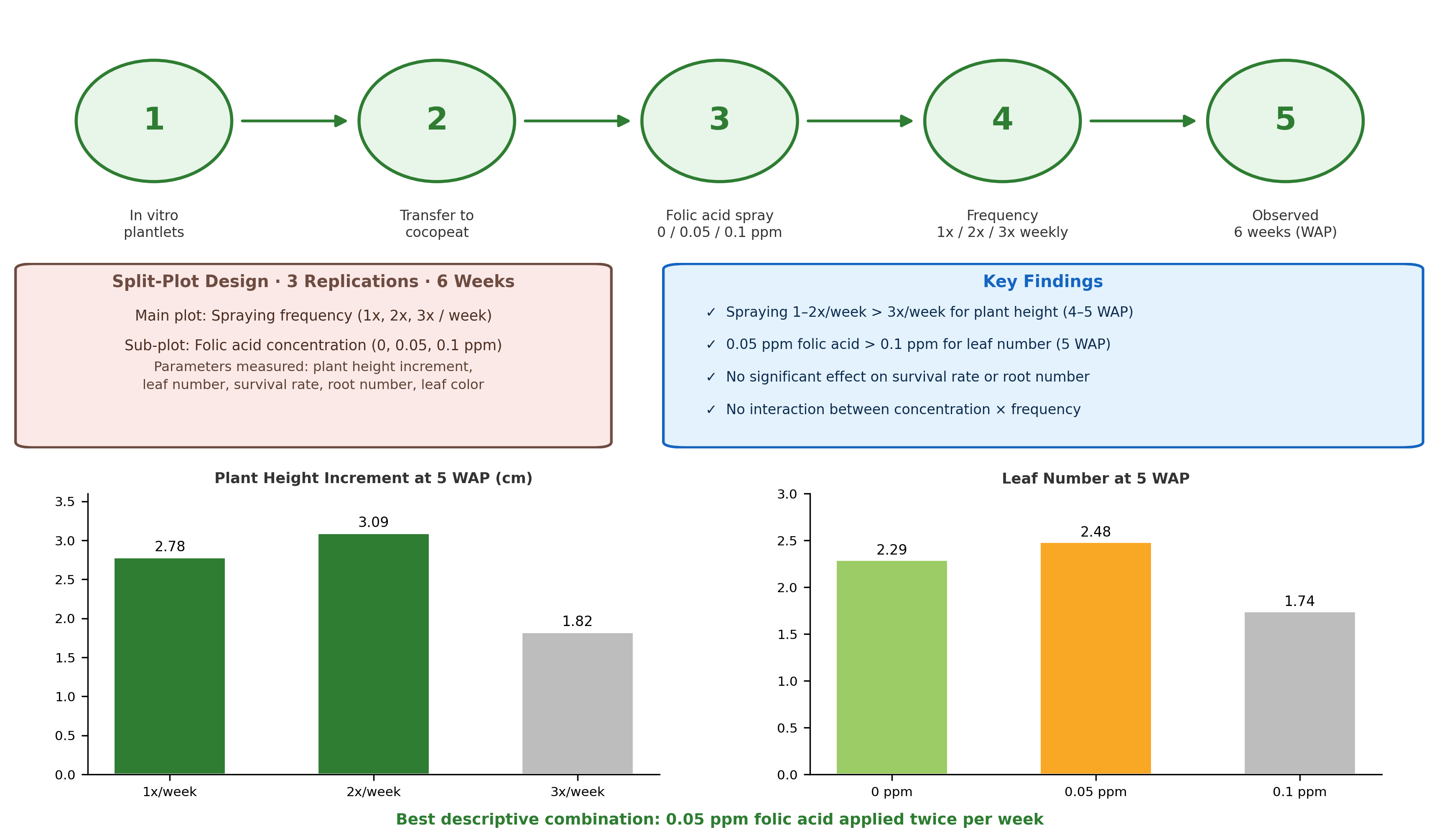
Acclimatization is a stage in potato micropropagation because in vitro-derived plantlets must adapt to ex vitro conditions. This study evaluated the effects of folic acid concentration and spraying frequency on Atlantic potato (Solanum tuberosum L.) plantlet growth during acclimatization. A split-plot design with three replications included spraying frequency (once, twice, or three times per week) as the main-plot factor and folic acid concentration (0, 0.05, or 0.1 ppm) as the subplot factor. Each experimental unit contained three plantlets. Spraying frequency significantly affected height increment at 3–6 weeks after planting (WAP), with three-times-weekly spraying producing lower growth than once- or twice-weekly spraying. Folic acid concentration and its interaction with spraying frequency significantly affected height increment at 3–5 WAP. Leaf number was affected by folic acid concentration at 3, 5, and 6 WAP, by spraying frequency at 3 and 6 WAP, and by their interaction at 5 WAP. At 6 WAP, untreated plantlets produced more leaves than folic-acid-treated plantlets. Root number was affected by both factors; 0.1 ppm folic acid reduced root number, whereas twice-weekly spraying produced the highest mean. Survival remained high across treatments. No treatment combination consistently optimized all growth responses. These findings provide a basis for refining folic acid application during potato acclimatization and highlight the need to separate spraying frequency from cumulative liquid volume and folic acid dose in future experiments.
References
Al-Maliky, A. W., Jerry, A. N., & Obead, F. I. (2019). The effects of foliar spraying of folic acid and cysteine on growth, chemical composition of leaves and green yield of faba bean (Vicia faba L.). Basrah Journal of Agricultural Sciences, 32(2), 223–229. https://doi.org/10.37077/25200860.2019.212
Al-Elwany, O. A. A. I., Hemida, K. A., Abdel-Razek, M. A., Abd El-Mageed, T. A., El-Saadony, M. T., AbuQamar, S. F., El-Tarabily, K. A., & Taha, R. S. (2022). Impact of folic acid in modulating antioxidant activity, osmoprotectants, anatomical responses, and photosynthetic efficiency of Plectranthus amboinicus under salinity conditions. Frontiers in Plant Science, 13, 887091. https://doi.org/10.3389/fpls.2022.887091
Astarini, I. A., Margareth, D., Febryanti, N. P. K., Defiani, M. R., & Temaja, I. G. R. M. (2023). Production of quality early-generation seed potatoes in Bali, Indonesia. IOP Conference Series: Earth and Environmental Science, 1133, 012013. https://doi.org/10.1088/1755-1315/1133/1/012013
Ayala-Rodríguez, J. Á., Barrera-Ortiz, S., Ruiz-Herrera, L. F., & López-Bucio, J. (2017). Folic acid orchestrates root development linking cell elongation with auxin response and acts independently of the TARGET OF RAPAMYCIN signaling in Arabidopsis thaliana. Plant Science, 264, 168–178. https://doi.org/10.1016/j.plantsci.2017.09.011
Bañuelos, J., Martínez-Romero, E., Montaño-Arias, N. M., & Camargo-Ricalde, S. L. (2025). Folic acid (vitamin B9) or inoculation with beneficial microbes enhances plant growth in Phaseolus vulgaris L. Terra Latinoamericana, 43, e2090. https://doi.org/10.28940/terralatinoamericana.v43i.2090
Basyal, P., Rajbahak, S., Ghimire, M., Maharjhan, S., Thapa, C. B., & Pant, B. (2025). Micropropagation and genetic homogeneity assessment of Curcuma aeruginosa Roxb. Plant Cell, Tissue and Organ Culture, 161(3), 84. https://doi.org/10.1007/s11240-025-03118-y
Chandra, S., Bandopadhyay, R., Kumar, V., & Chandra, R. (2010). Acclimatization of tissue-cultured plantlets: From laboratory to land. Biotechnology Letters, 32(9), 1199–1205. https://doi.org/10.1007/s10529-010-0290-0
Davies, F. T., Geneve, R. L., & Wilson, S. B. (2018). Hartmann & Kester's plant propagation: Principles and practices (9th ed.). Pearson Education.
Dewir, Y. H., Al-Ali, A. M., Rihan, H. Z., Alshahrani, T., Alwahibi, M. S., Almutairi, K. F., Naidoo, Y., & Fuller, M. P. (2023). Effects of artificial light spectra and sucrose on the leaf pigments, growth, and rooting of blackberry (Rubus fruticosus) microshoots. Agronomy, 13(1), 89. https://doi.org/10.3390/agronomy13010089
Eisa, E. A., Pasquel Davila, D. S., & Ördögh, M. (2025). Enhancing acclimatization conditions for Vriesea splendens ‘Fire’: A comparative analysis of substrate effects on growth and survival. Plants, 14(2), 172. https://doi.org/10.3390/plants14020172
Fernández, V., Gil-Pelegrín, E., & Eichert, T. (2021). Foliar water and solute absorption: An update. The Plant Journal, 105(4), 870–883. https://doi.org/10.1111/tpj.15090
Gomez, K. A., & Gomez, A. A. (1984). Statistical procedures for agricultural research (2nd ed.). John Wiley & Sons.
Gorelova, V., Ambach, L., Rébeillé, F., Stove, C., & Van Der Straeten, D. (2017). Folates in plants: Research advances and progress in crop biofortification. Frontiers in Chemistry, 5, 21. https://doi.org/10.3389/fchem.2017.00021
Grzelak, M., Pacholczak, A., & Nowakowska, K. (2024). Challenges and insights in the acclimatization step of micropropagated woody plants. Plant Cell, Tissue and Organ Culture, 159, 72. https://doi.org/10.1007/s11240-024-02923-1
Hailu, A., Sbhatu, D. B., & Abraha, H. B. (2020). In vitro micropropagation of industrially and medicinally useful plant Aloe trichosantha Berger using offshoot cuttings. The Scientific World Journal, 2020, 3947162. https://doi.org/10.1155/2020/3947162
Hajare, S. T., Chauhan, N. M., & Kassa, G. (2021). Effect of growth regulators on in vitro micropropagation of potato (Solanum tuberosum L.) Gudiene and Belete varieties from Ethiopia. The Scientific World Journal, 2021, 5928769. https://doi.org/10.1155/2021/5928769
Hazarika, B. N. (2003). Acclimatization of tissue-cultured plants. Current Science, 85(12), 1704–1712.
Ibrahim, M. F. M., Ibrahim, H. A., & Abd El-Gawad, H. G. (2021). Folic acid as a protective agent in snap bean plants under water deficit conditions. The Journal of Horticultural Science and Biotechnology, 96(1), 94–109. https://doi.org/10.1080/14620316.2020.1793691
Jiang, L., Strobbe, S., Van Der Straeten, D., & Zhang, C. (2021). Regulation of plant vitamin metabolism: Backbone of biofortification for the alleviation of hidden hunger. Molecular Plant, 14(1), 40–60. https://doi.org/10.1016/j.molp.2020.11.019
Jones, B., & Nachtsheim, C. J. (2009). Split-plot designs: What, why, and how. Journal of Quality Technology, 41(4), 340–361. https://doi.org/10.1080/00224065.2009.11917790
Karyanti, Khairiyah, H., Sukarnih, T., Rudiyana, Y., Nasrifah, I., Wulansari, A., Septiani, S. M., & Dasumiati. (2022). Micropropagation of potato (Solanum tuberosum L.) cv. Granola in liquid medium using an aeration system for G0 seed production. Jurnal Bioteknologi & Biosains Indonesia, 9(2), 158–169. https://doi.org/10.55981/jbbi.2022.1751
Khan, M. T., Ahmed, S., Sardar, R., Shareef, M., Abbasi, A., Mohiuddin, M., Ercisli, S., Fiaz, S., Marc, R. A., Attia, K., Khan, N., & Golokhvast, K. S. (2022). Impression of foliar-applied folic acid on coriander (Coriandrum sativum L.) to regulate aerial growth, biochemical activity, and essential oil profiling under drought stress. Frontiers in Plant Science, 13, 1005710. https://doi.org/10.3389/fpls.2022.1005710
Kulus, D., & Tymoszuk, A. (2024). Advancements in in vitro technology: A comprehensive exploration of micropropagated plants. Horticulturae, 10(1), Article 88. https://doi.org/10.3390/horticulturae10010088
Kusmana. (2012). Uji adaptasi klon kentang hasil persilangan varietas Atlantik sebagai bahan baku keripik kentang di dataran tinggi Pangalengan. Jurnal Hortikultura, 22(4), 342–348. https://doi.org/10.21082/jhort.v22n4.2012.p342-348
Lommen, W. J. M. (2024). Effects of age of in vitro-derived potato plantlets on early above- and below-ground development after planting in different cultivars. Potato Research, 67(1), 93–115. https://doi.org/10.1007/s11540-023-09621-z
Morais, T. P., Asmar, S. A., Silva, H. F. de J., Luz, J. M. Q., & Melo, B. de. (2018). Application of tissue culture techniques in potato. Bioscience Journal, 34(4), 952–969. https://doi.org/10.14393/BJ-v34n1a2018-38775
Murashige, T., & Skoog, F. (1962). A revised medium for rapid growth and bio assays with tobacco tissue cultures. Physiologia Plantarum, 15(3), 473–497. https://doi.org/10.1111/j.1399-3054.1962.tb08052.x
Naik, R., Bhusan, A., Singh, B., Kumar, S., Sharma, S., Kumar, R., & Nishant. (2025). Enhancing acclimatization of in vitro raised potato seedlings via biological hardening. Indian Journal of Horticulture, 82(3), 291–296. https://doi.org/10.58993/ijh/2025.82.3.6
Nasution, M. W. A., Siregar, L. A. M., & Basyuni, M. (2025). Optimization medium at the propagation and formation stage of micro tubers some varieties of potato. Indonesian Journal of Agricultural Research, 8(1), 9–16. https://doi.org/10.32734/injar.v8i1.16798
Nejatzadeh, F. (2024). Effect of foliar application frequency and different levels of nano fertilizer on growth and development of coriander (Coriandrum sativum L.). Heliyon, 10(11), e31732. https://doi.org/10.1016/j.heliyon.2024.e31732
Omar, A., Zayed, B., Abdel Salam, A., Hafez, Y. M., & Abdelaal, Kh. A. A. (2020). Folic acid as foliar application can improve growth and yield characters of rice plants under irrigation with drainage water. Fresenius Environmental Bulletin, 29(10), 9420–9428.
Onofri, A. (2007). Routine statistical analyses of field experiments by using an Excel® extension. Proceedings of the 6th National Congress of the Italian Biometric Society: "La statistica nelle scienze della vita e dell'ambiente," Pisa, 20-22 June 2007, 93-96.
Pompelli, M. F., García-Castaño, S. G., Vásquez-Bettin, A. M., Dey, P., Seleiman, M. F., Alotaibi, M., Perneth-Montaño, M. J., & Guerra, M. P. (2025). Effect of indole-3-butyric acid (IBA) and 3-indoleacetic acid (IAA) on promoting roots on micropropagated Dyckia distachya Hassl. South African Journal of Botany, 184, 387. https://doi.org/10.1016/j.sajb.2025.06.003
Rahman, M. H., Islam, M. J., Mumu, U. H., Ryu, B. R., Lim, J.-D., Azad, M. O. K., Cheong, E. J., & Lim, Y.-S. (2024). Effect of light quality on seed potato (Solanum tuberosum L.) tuberization when aeroponically grown in a controlled greenhouse. Plants, 13(5), 737. https://doi.org/10.3390/plants13050737
Royal Horticultural Society. (2015). RHS colour chart (6th ed.).
Sahito, Z. A., Zehra, A., Yu, S., Chen, S., Arif, M. A. R., Raza, S. T., Lahori, A. H., Mwaheb, M. A., He, Z., & Yang, X. (2024). Folic acid supplementation improves seed germination, seedling growth and cadmium uptake in a mining ecotype of Solanum nigrum L. Environmental Technology & Innovation, 34, 103600. https://doi.org/10.1016/j.eti.2024.103600
Sharma, N., Kumar, N., James, J., Kalia, S., & Joshi, S. (2023). Strategies for successful acclimatization and hardening of in vitro regenerated plants: Challenges and innovations in micropropagation techniques. Plant Science Today, 10(SP2), 90–97. https://doi.org/10.14719/pst.2376
Shrestha, S., Panthi, B., Manandhar, D., Dawadi, N., Poudel, P. R., & Kunwar, P. (2026). Effect of indole-3-butyric acid on in vitro rooting and shoot development of potato (Solanum tuberosum L.) under activated charcoal-supplemented conditions. Cogent Food & Agriculture. https://doi.org/10.1080/23311932.2026.2656508
Sipayung, A. M., & Damanik, R. (2024). The response to various concentrations of IBA hormone and transplanting time of potato plantlets cultivar of Medians. IOP Conference Series: Earth and Environmental Science, 1297(1), 012063. https://doi.org/10.1088/1755-1315/1297/1/012063
Vollmer, R., Espirilla, J., Espinoza, A., Villagaray, R., Castro, M., Pineda, S., Sánchez, J. C., Mello, A. F. S., & Azevedo, V. C. R. (2024). Effect of gas exchange rate, vessel type, planting density, and genotype on growth, photosynthetic activity, and ion uptake of in vitro potato plants. Plants, 13(19), 2830. https://doi.org/10.3390/plants13192830
Youssif, S. B. D. (2017). Response of potatoes to foliar spray with cobalamin, folic acid and ascorbic acid under North Sinai conditions. Middle East Journal of Agricultural Research, 6(3), 662–672.
Downloads
Additional Files
Published
Issue
Section
License
Copyright (c) 2026 Jurnal Ilmiah Pertanian

This work is licensed under a Creative Commons Attribution 4.0 International License.