Soil physical properties and organic matter govern available water in Inceptisols under different land uses
DOI:
https://doi.org/10.31849/29056Keywords:
bulk density, soil porosity, soil organic matter, tropical soils, land managementAbstract
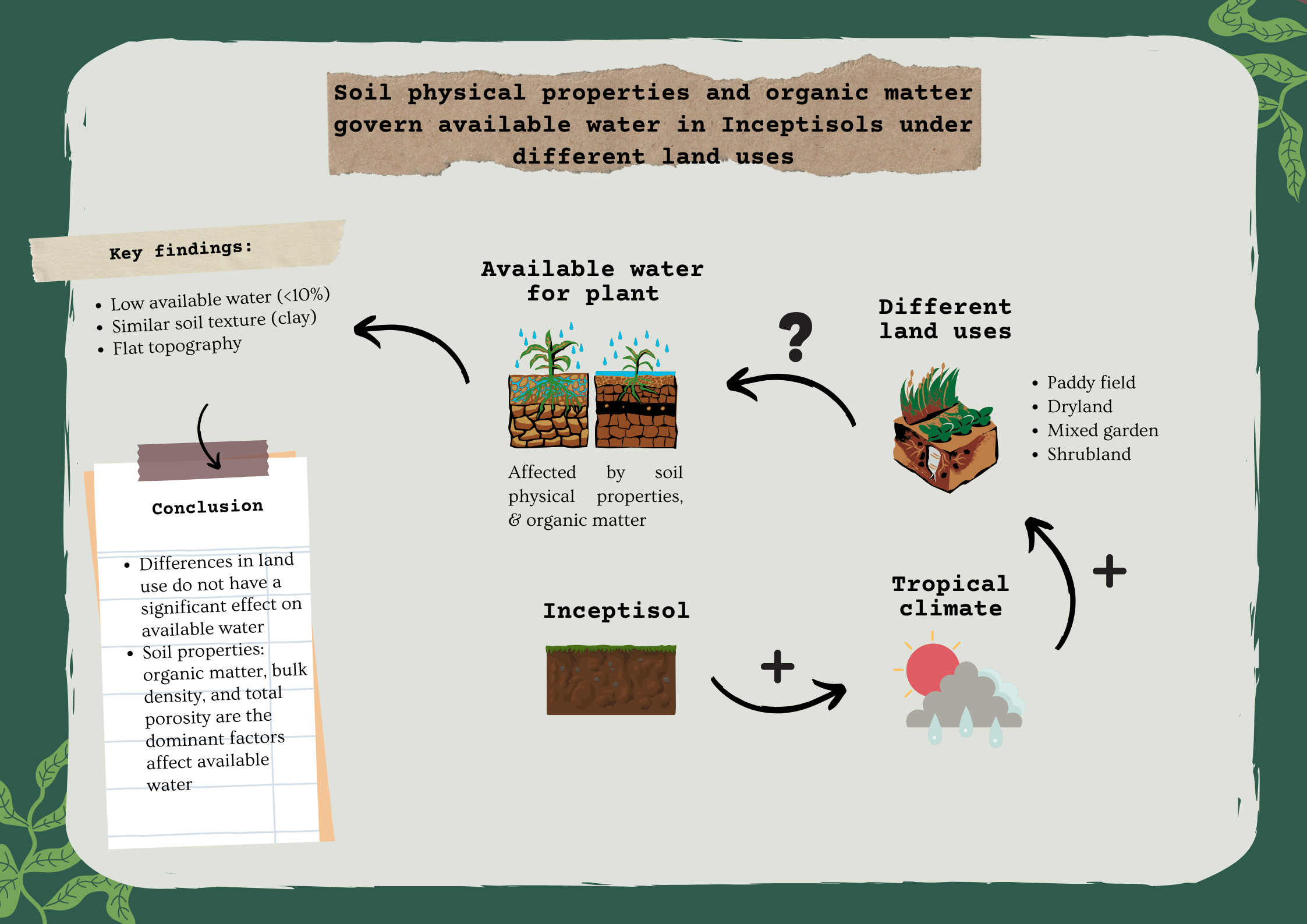
Understanding soil water availability is critical for sustainable land management in tropical agricultural systems, particularly in Inceptisols that often exhibit inherent physical constraints. This study aimed to evaluate the influence of soil physical properties and organic matter on available water under different land uses. The study was conducted in a representative Inceptisol landscape in Beji District, Pasuruan, Indonesia. Soil samples were collected from four land use types at two depths (0–30 cm and 30–60 cm), and key properties including bulk density, porosity, texture, and soil organic matter were analyzed along with soil water retention characteristics. The results showed that available water content was consistently low across all land uses, with values generally below 10%, and no significant differences were observed among land use types (p > 0.05). In contrast, soil properties exhibited significant relationships with available water. Soil organic matter and porosity were positively associated with water availability, whereas bulk density showed a negative relationship. Multiple regression analysis indicated that these variables jointly explained a substantial proportion of the variation in available water. These findings suggest that intrinsic soil properties, particularly soil physical characteristics and organic matter, play a more dominant role than land use in regulating water availability in Inceptisols. Improving soil organic matter may be more effective for enhancing soil water availability than changing land use.
References
Abdallah, A. M., Jat, H. S., Choudhary, M., Abdelaty, E. F., Sharma, P. C., & Jat, M. L. (2021). Conservation agriculture effects on soil water holding capacity and water-saving varied with management practices and agroecological conditions: A Review. Agronomy, 11(9), 1681. https://doi.org/10.3390/agronomy11091681
Atmanto, M. D. (2017). Hubungan bulk density dan permeabilitas tanah di wilayah kerja migas blok east. Lembaran publikasi minyak dan gas bumi, 51(1), 23-29. https://doi.org/10.29017/LPMGB.51.1.12
Akbar, F. A., Suharyatun, S., Amien, E. R., & Tusi, A. (2024). Analisis kapasitas tanah menahan air (Water Holding Capacity) pada penambahan biochar berbahan pelepah kelapa sawit (Elaeis guineensis Jacq). Jurnal Agricultural Biosystem Engineering, 3(1), 133-147. https://doi.org/10.23960/jabe.v3i1.8928
Bayala, J., & Prieto, I. (2020). Water acquisition, sharing and redistribution by roots: applications to agroforestry systems. Plant and Soil, 453(1), 17-28. https://doi.org/10.1007/s11104-019-04173-z
Bintoro, A., Widjajanto, D. & Isrun. (2017). Karakteristik fisik tanah pada beberapa penggunaan lahan di Desa Beka Kecamatan Marawola. e-J. Agrotekbis 5 (4): 423 – 430.
Dou, F., Soriano, J., Tabien, R. E., & Chen, K. (2016). Soil texture and cultivar effects on rice (Oryza sativa, L.) gain yield, yield components and water productivity in three water regimes. PloS one, 11(3), e0150549. https://doi.org/10.1371/journal.pone.0150549
Ermawati, E., Kusuma, Z., & Wicaksono, K. S. (2023). Impact of land use on soil water retention in inceptisols of the upper konto watershed. Journal of Tropical Soils, 29(3), 167–177. https://doi.org/10.5400/jts.2024.v29i3.167-177
Gao, Y., He, Z., Zhu, X., Chen, L., & Du, J. (2022). Light thinning can improve soil water availability and water holding capacity of plantations in alpine mountains. Frontiers in Plant Science, 13, 1032057. https://doi.org/10.3389/fpls.2022.1032057
Giap, G. E., Rudiyanto, & Sulaiman, M. S. (2021). Water infiltration into sand, silt, and clay at field capacity. J Adv Res Fluid Mech Therm Sci, 84(2), 159-166. https://doi.org/10.37934/arfmts.84.2.159166
Gulo, A. A., S. & Gulo, G. N. H. (2024). Dinamika gerakan air di tanah: pengaruh tekstur, struktur, dan kepadatan bulk. Jurnal Ilmu Pertanian dan Perikanan, 1(2), 133-137. https://doi.org/10.70134/penarik.v1i2.219
Gultom, I., Maroeto, M., & Arifin, M. (2022). Kajian degadasi lahan akibat kegiatan pertambangan untuk pengembalian fungsi lahan. Jurnal Agium, 19(1), 36-46. https://doi.org/10.29103/agrium.v19i1.6765
Hartanto, N., Zulkarnain, & Wicaksono, A. (2022). Analisis beberapa sifat fisik tanah sebagai indikator kerusakan tanah pada lahan kering. Agroekoteknologi Tropika Lembab, 4(2), 107–112. http://dx.doi.org/10.35941/jatl.4.2.2022.7001.107-112
Irawan T. & Yuwono, S. B. (2016). Infiltrasi pada berbagai tegakan hutan di Arboretum Universitas Lampung. Jurnal Sylva Lestari, 4(3), 21-34. https://doi.org/10.23960/jsl3421-34
Isra, N., Lias, S. A., & Ahmad, A. (2019). Karakteristik ukuran butir dan mineral liat tanah pada kejadian longsor (Studi Kasus: Sub Das Jeneberang). Jurnal Ecosolum, 8(2), 62-73. https://doi.org/10.20956/ecosolum.v8i2.7874
Kebebew, S., Bedadi, B., Erkossa, T., Yimer, F., & Wogi, L. (2022). effect of different land-use types on soil properties in Cheha District, South-central Ethiopia. Sustainability, 14(3), 1323. https://doi.org/10.3390/su14031323
Khalimi, Farik & Kusuma, Zaenal. (2018). Analisis ketersediaan air pada pertanian lahan kering di Gunungkudul Yogyakarta. Jurnal Tanah dan Sumberdaya Lahan, 5(1), 721-725. https://jtsl.ub.ac.id/index.php/jtsl/article/view/191
Khodijah, Siti & Soemarno. (2019). Studi kemampuan tanah menyimpan air tersedia di sentra bawang putih kecamatan pujon, Kabupaten Malang. Jurnal Tanah dan Sumberdaya Lahan, 6(2), 1405-1414. https://doi.org/10.21776/ub.jtsl.2019.006.2.21
Khoi, D. N., Nguyen, V. T., Sam, T. T., Mai, N. T. H., Vuong, N. D., & Cuong, H. V. (2021). Assessment of climate change impact on water availability in the upper Dong Nai River Basin, Vietnam. Journal of Water and Climate Change, 12(8), 3851–3864. https://doi.org/10.2166/wcc.2021.255
Krnáčová, Z., Barančoková, M., & Labuda, M. (2025). Quantification of soil water retention capacity in the protected water management area Žitný Ostrov (Slovakia). Agriculture, 15(5), 563. https://doi.org/10.3390/agriculture15050563
Kuyah, S., Öborn, I., Jonsson, M., Dahlin, A. S., Barrios, E., Muthuri, C., Malmer, A., Nyaga, J., Magaju, C., Namirembe, S., Nyberg, Y., & Sinclair, F. L. (2016). Trees in agricultural landscapes enhance provision of ecosystem services in Sub-Saharan Africa. International Journal of Biodiversity Science, Ecosystem Services & Management, 12(4), 255-273. https://doi.org/10.1080/21513732.2016.1214178
Lal, R. (2020). Soil organic matter and water retention. Agronomy Journal, 112(5), 3265-3277. https://doi.org/10.1002/agj2.20282
Lana-Renault, N., Romero, E. N., Cammeraat, E., & Llorente, J. Á. (Eds.). (2020). Impact of Farmland Abandonment on Water Resources and Soil Conservation. MDPI. https://doi.org/10.3390/books978-3-03936-612-5
Masria, M., Lopulisa, C., Zubair, H., & Rasyid, B. (2018). Karakteristik pori dan hubungannya dengan permeabilitas pada tanah vertisol asal jeneponto sulawesi selatan. Jurnal Ecosolum, 7(1), 38–45. https://doi.org/10.20956/ecosolum.v7i1.5209
Nedbal, V., Bernasova, T., Kobesova, M., Tesařová, B., Vácha, A., & Brom, J. (2025). Impact of landscape management and vegetation on water and nutrient runoff from small catchments for over 20 years. Journal of Environmental Management, 373, 123748. https://doi.org/10.1016/j.jenvman.2024.123748
Nuraida, Alim, N., & Arhim, M. (2021). Analisis kadar air, bobot isi dan porositas tanah pada beberapa penggunaan lahan. Prosiding Biologi Achieving the Sustainable Development Goals with Biodiversity in Confronting Climate Change, 7(1), 357-361. https://doi.org/10.24252/psb.v7i1.24703
Putrantyo, A. R. (2017). Aplikasi Mulsa Organik Pada Lahan Salak: Pengaruh Peningkatan Bahan Organik Tanah terhadap Porositas dan Infiltrasi Tanah (Doctoral dissertation, Universitas Brawijaya).http://repository.ub.ac.id/id/eprint/4350
Rahmadani, D., Sasongko, P. E., & Wijaya, K. (2023). Prediksi kemampuan tanah dalam menahan air pada berbagai tipe penggunaan lahan di Desa Karangpatihan, Kecamatan Balong, Kabupaten Ponorogo Menggunakan Karakteristik Tanah yang Tersedia. Indonesian Journal of Agricultural Sciences, 25, 66-73. https://doi.org/10.31186/jipi.25.2.66-73
Sari, D. N., Priyana, Y., & Cholil, M. (2015). Analisis Penggunaan Lahan Tahun 2013 Terhadap Ketersediaan Air di Sub Daerah Aliran Sungai Blongkeng (Doctoral dissertation, Universitas Muhammadiyah Surakarta). http://eprints.ums.ac.id/id/eprint/38466
Talat, A. E., Wang, J., & El-Sorogy, A. S. (2025). Impact of soil compaction on pore characteristics and hydraulic properties by using x-ray ct and soil water retention curve in China’s Loess Plateau. Water, 17(8), 1144. https://doi.org/10.3390/w17081144
Xu, B., Shao, D., Fang, L., Yang, X., Chen, S., & Gu, W. (2019). Modelling percolation and lateral seepage in a paddy field-bund landscape with a shallow groundwater table. Agricultural Water Management, 214, 87-96. https://doi.org/10.1016/j.agwat.2018.11.008
Xue, D., Tian, J., Zhang, B., Kang, W., & He, C. (2025). Evaluating the effect of vegetation type and topography on infiltration process in an arid mountainous area: Insights from continuous soil moisture monitoring network. Agricultural Water Management, 315, 109537. https://doi.org/10.1016/j.agwat.2025.109537
Downloads
Published
Issue
Section
License
Copyright (c) 2026 Universitas Lancang Kuning

This work is licensed under a Creative Commons Attribution 4.0 International License.