Predator communities associated with Spodoptera exigua in tropical shallot agroecosystems
DOI:
https://doi.org/10.31849/29660Keywords:
biological control, arthropod diversity, ecological indices, natural enemy conservation, pest population dynamicsAbstract
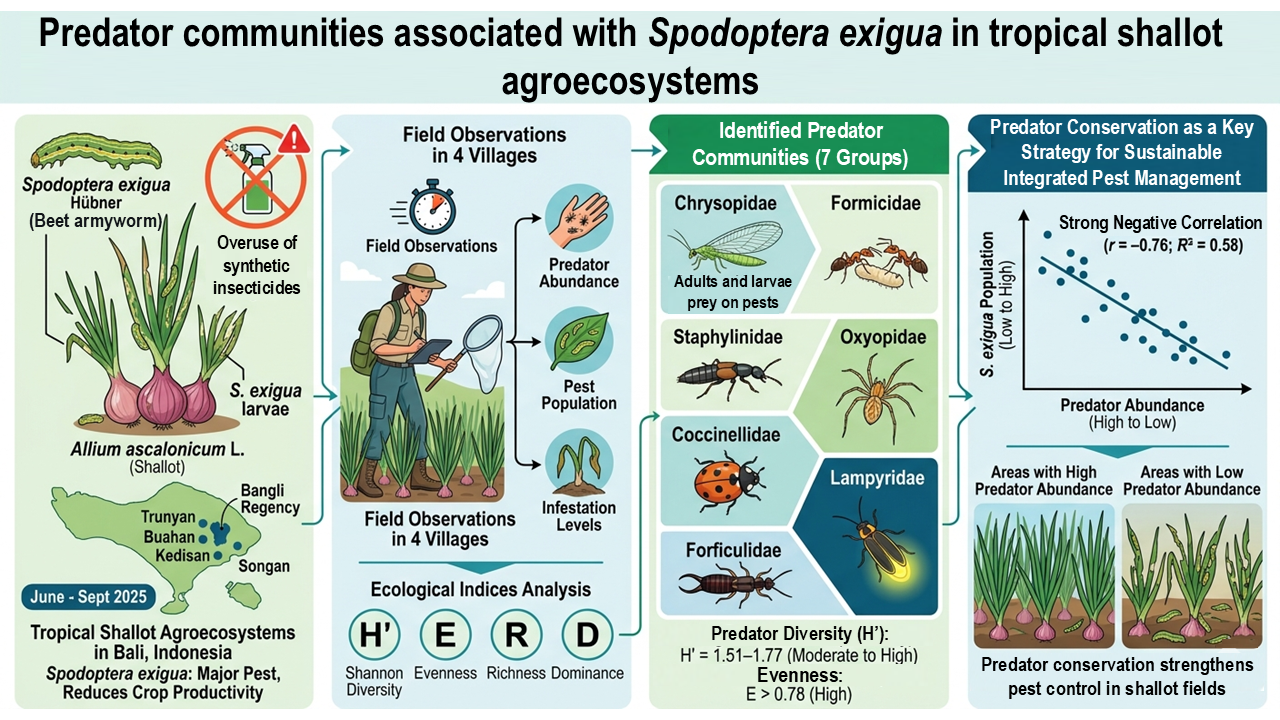
Spodoptera exigua Hübner is a major pest of shallot (Allium ascalonicum L.) that can significantly reduce productivity in tropical agroecosystems. Pest control in shallot cultivation still relies heavily on synthetic insecticides, which may lead to pest resistance and negatively affect natural enemy populations. This study identified predator communities associated with S. exigua in tropical shallot agroecosystems in Bangli Regency, Bali, Indonesia. Field observations were conducted in four shallot-producing villages (Trunyan, Buahan, Kedisan, and Songan) from June to September 2025. Predator abundance, pest population, and infestation levels were analyzed using ecological indices including Shannon diversity (H′), evenness (E), species richness (R), and dominance (D). Seven predator groups were identified, with moderate to high diversity (H′ = 1.51–1.77) and high evenness (E > 0.78). Predator abundance showed a strong negative correlation with S. exigua population (r = −0.76; R² = 0.58). These results highlight the importance of predator conservation in sustainable integrated pest management for tropical shallot production.
References
Boldorini, G. X., Mccary, M. A., Romero, G. Q., Mills, K. L., Sanders, N. J., Reich, P. B., Michalko, R., & Gonçalves-Souza, T. (2024). Predators control pests and increase yield across crop types and climates: a meta-analysis. Proceedings of the Royal Society B: Biological Sciences, 291(2018). https://doi.org/10.1098/rspb.2023.2522
Borror, D. J., Triplehorn, C. A., & Johnson, N. F. (1989). An introduction to the study of insects (6th ed.). Saunders College Publishing.
Dirgayana, I. W., Supartha, I. W., & Wijaya, I. N. (2021). Predation and response test functional predator Chrysoperla carnea Stephens (Neuroptera: Chrysopidae) against Phenacoccus Manihoti Matile-Ferrero (Hemiptera: Pseudococcidae). Agrotropes: Journal on Agricultural Science, 11(1), 76–84. https://doi.org/10.24843/AJoAS.2021.v11.i01.p08
Ehler, L. E. (2004). An evaluation of some natural enemies of Spodoptera exigua on sugarbeet in Northern California. BioControl, 49, 121-135. https://doi.org/10.1023/B:BICO.0000017364.20596.38
Evans, E. W., & Toler, T. R. (2007). Aggregation of polyphagous predators in response to Multiple prey: ladybirds (Coleoptera: Coccinellidae) foraging in Alfalfa. Population Ecology, 49(1), 29-36. https://doi.org/10.1007/s10144-006-0022-4
Ghosh, D., & Borzée, A. (2024). Biological pest regulation can benefit from diverse predation modes. Royal Society Open Science, 11(9). https://doi.org/10.1098/rsos.240535
Ginting, T. Y., Setiawan, A., Aziz, M. F. A., & Aezad, M. H. (2024). Management population pest Spodoptera exigua Hübner (Lepidoptera; Noctuidae ) with refugia on onion plants red. Agroplasm Journal, 11(1), 201-207. https://doi.org/10.36987/agroplasma.v11i1.5630
Hairston, N. G., Smith, F. E., & Slobodkin, L. B. (1960) Community structure, population control, and competition. American Naturalist, 94(879), 421-425. http://dx.doi.org/10.1086/282146
Jalloh, A. A., Uyi, O., Chitturi, A., Basu, S., Mutiso, J. M., Perier, J. D., Ejomah, A., Owolanke, T. A., Mutyambai, D. M., & Toews, M. D. (2025). Harnessing natural enemies for sustainable management of Bemisia tabaci: a review of the role of predators, parasitoids and entomopathogens. Frontiers in Agronomy, 7, 1684672. https://doi.org/10.3389/fagro.2025.1684672
Landis, D. A., Wratten, S. D., & Gurr, G. M. (2000). Habitat management to conserve natural enemies of arthropod pests in agriculture. Annual review of entomology, 45(1), 175-201. https://doi.org/10.1146/annurev.ento.45.1.175
Lisi, F., Siscaro, G., Biondi, A., Zappalà, L., & Ricupero, M. (2025). Non-target effects of bioinsecticides on natural enemies of arthropod pests. Current Opinion in Environmental Science & Health, 45, 100624. https://doi.org/10.1016/j.coesh.2025.100624
Magurran, A. E. (1988). Ecological diversity and its measurement. Princeton University Press. https://doi.org/10.1007/978-94-015-7358-0
Marhaen, L. S., Aprianto, F., Hasyim, A., & Lukman, L. (2016). Potensi campuran Spodoptera exigua Nucleopolyhedrovirus (SeNPV) dengan insektisida botani untuk meningkatkan mortalitas ulat bawang Spodoptera exigua (Hubner)(Lepidoptera: Noctuidae) di laboratorium. Jurnal Hortikultura, 26(1), 103-112. https://doi.org/10.21082/jhort.v26n1.2016.p103-112
Masson, A., Rastello, K., Sacco‐Martret de Préville, A., Tricault, Y., Poggi, S., Canard, E., Etienne, M. P., & Plantegenest, M. (2025). Unveiling the Hidden Feast: A Model to Translate Molecular Detection Into Predation Rate—Application Example on Biological Control by Generalist Predators in Agricultural Fields. Molecular Ecology Resources, 25(8), e70033. https://doi.org/10.1111/1755-0998.70033
Nève de Mévergnies, T., Delauney, T., Tixier, M. S., Gendron Hoareau, C., Huat, J., & Chailleux, A. (2026). Ecological and management drivers of pest regulation via multitrophic pathways in tropical insular agroecosystems. Agriculture, Ecosystems and Environment, 397, 110030. https://doi.org/10.1016/j.agee.2025.110030
Pandey, S., Johnson, A. C., Xie, G., & Gurr, G. M. (2022). Pesticide regime can negate the positive influence of native vegetation donor habitat on natural enemy abundance in adjacent crop fields. Frontiers in Ecology and Evolution, 10, 815162. https://doi.org/10.3389/fevo.2022.815162
Purnama, I., Malhat, F. M., Mutamima, A., Ihsan, F., & Amalia. (2023). A comparative study on pesticide residue profiles in locally grown rice from conventional and sustainable agricultural methods. Jurnal Ilmiah Pertanian, 20(3), 219-231. https://doi.org/10.31849/jip.v20i3.17122
Purwaningsih, H., Sudartha, I M., & Fauzi, M.T. (2023). Diversity of insect pests in the onion plant (Allium ascalonicum L.) in the village of Kebon Ayu West Lombok. Journal Agrocomplex Student Scientific, 2(2), 236 – 246. https://doi.org/10.29303/jima.v2i2.2635
Putrasamedja, S., & Suwandi. (1996). Bawang merah di Indonesia. Balai Penelitian Tanaman Sayuran. https://repository.pertanian.go.id/handle/123456789/10056
Quandahor, P., Kim, L., Kim, M., Lee, K., Kusi, F., & Jeong, I. H. (2024). Effects of agricultural pesticides on decline in insect species and individual numbers. Environments, 11(8), 182. https://doi.org/10.3390/environments11080182
Shannon, C. E., & Weaver, W. (1949). The mathematical theory of communication. Urbana, IL: University of Illinois Press.
Simpson, E. H. (1949) Measurement of diversity, Nature, 163(688) 1949. https://doi.org/10.1038/163688a0
Sugiura, S. (2020). Predators as drivers of insects defenses. Entomological Science, 23(3), 316–337. https://doi.org/10.1111/ens.12423
Supartha, I. W., Susila, I. W., Sumiartha, I. K., Rauf, A., Cruz, L. B. D. C., Yudha, I. K. W., Utama, I. W. E. K., & Wiradana, P. A. (2022). Preference, population development, and molecular characteristics of Spodoptera exigua (Lepidoptera: Noctuidae) on shallot cultivars: A Field Trial Scale. Biodiversity. 23(2), 783-792 https://doi.org/10.13057/biodiv/d230224
Supyani, Noviayanti, P. & Wijayanti, R. (2014). Insecticidal properties of Spodoptera exigua nuclear polyhedarosis virus local isolate against Spodoptera exigua on shallot. International Journal of Entomological Research, 2(3),175-180. https://esciencepress.net/journals/IJER/article/view/947
Susanto, A., Naza, S. K., Muslimah, N., Nurmalasari, I., Maharani, Y., Natawigena, W. D., & Subakti Putri, S. N. (2024). Investigating Spodoptera spp. diversity, percentage of attack, and control strategies in the West Java, Indonesia, corn cultivation. Open Agriculture, 9(1), 20220340. https://doi.org/10.1515/opag-2022-0340
Tamburini, G., Bommarco, R., Wanger, T. C., Kremen, C., Van Der Heijden, M. G., Liebman, M., & Hallin, S. (2020). Agricultural diversification promotes multiple ecosystem services without compromising yield. Science Advances, 6(45), eaba1715. https://doi.org/10.1126/sciadv.aba1715
Taradipha, M. R. R., Rushayati, S. B., & Haneda, N. F. (2019). Characteristic environment to community insects . Journal Management Resource Nature and Environment, 9(2), 394–404. https://doi.org/10.29244/jpsl.9.2.394-404
Tscharntke, T., Klein, A. M., Kruess, A., Steffan‐Dewenter, I., & Thies, C. (2005). Landscape perspectives on agricultural intensification and biodiversity–ecosystem service management. Ecology Letters, 8(8), 857-874. https://doi.org/10.1111/j.1461-0248.2005.00782.x
Vălean, A. M., Suciu, L., Tărău, A., Șopterean, L., Russu, F., Șimon, A., Chețan, F., & Tritean, N. (2025). Impact of Shelterbelts on the Diversity and Dynamics of Natural Enemies in Wheat Agroecosystems. Agronomy, 15(9), 2153. https://doi.org/10.3390/agronomy15092153
Wulandari, A., & Syarifah, F. (2021). Inventory of refugia plants potentially medicinal in the agricultural area of Plandaan Subdistrict, Jombang Regency, East Java Province. Jurnal Ilmiah Pertanian, 18(1), 12-19. https://doi.org/10.31849/jip.v18i1.7158
Yu, X. L., Tang, R., Xia, P. L., Wang, B., Feng, Y., & Liu, T. X. (2020). Effects of prey distribution and heterospecific interactions on the functional response of Harmonia axyridis and Aphidius gifuensis to Myzus persicae. Insects, 11(6), 325. https://doi.org/10.3390/insects11060325
Downloads
Published
Issue
Section
License
Copyright (c) 2026 Universitas Lancang Kuning

This work is licensed under a Creative Commons Attribution 4.0 International License.