Land type drives pest infestation patterns in smallholder cocoa (Theobroma cacao L.) agroecosystems
DOI:
https://doi.org/10.31849/31590Keywords:
cocoa agroecosystems, pest infestation, land type, tropical agriculture, pest dynamicsAbstract
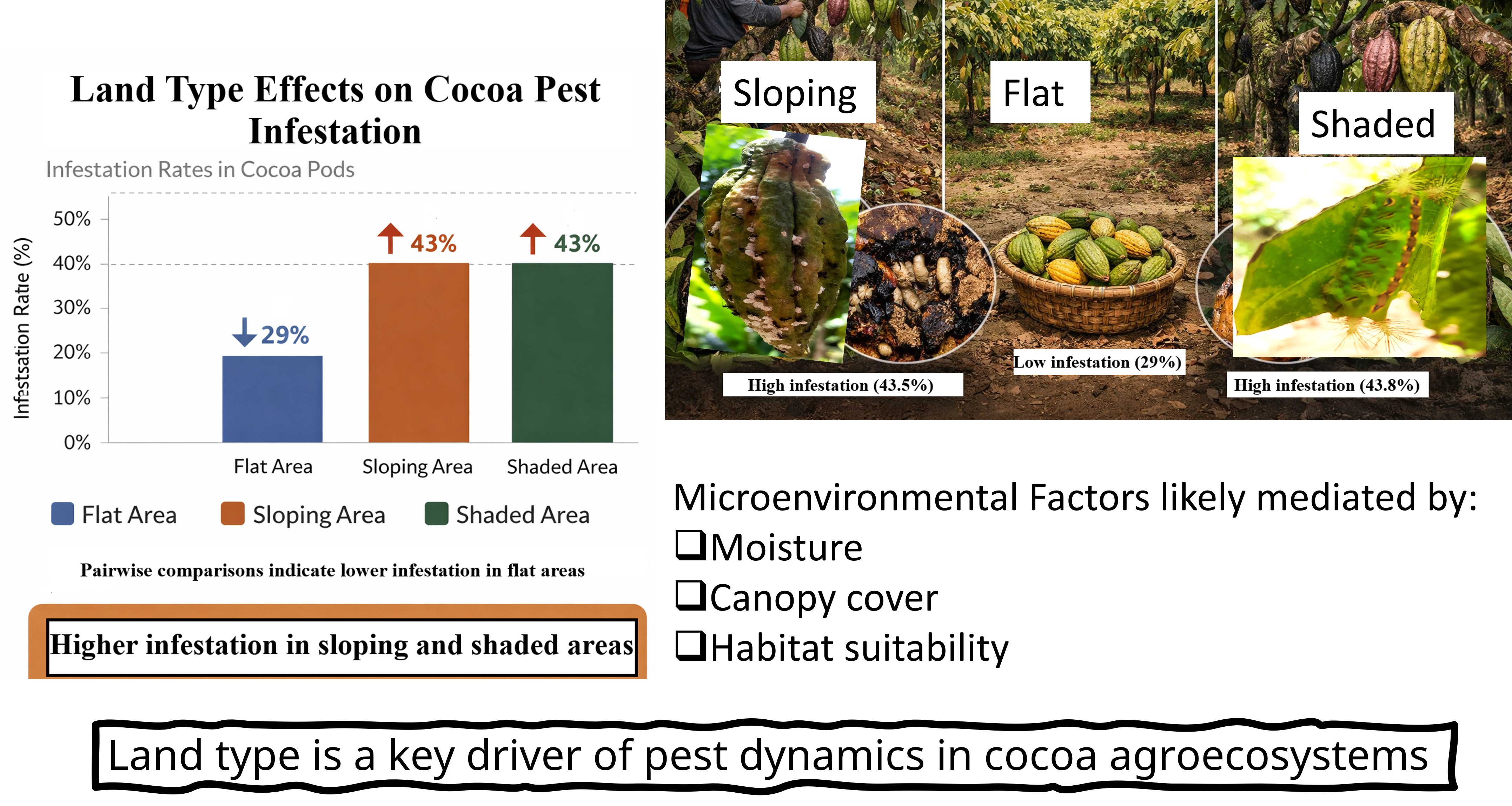
Pest infestation remains a major constraint in smallholder cocoa (Theobroma cacao L.) production, particularly in tropical agroecosystems where environmental heterogeneity can influence pest dynamics. However, the role of land type in shaping pest infestation patterns under field conditions is still insufficiently understood. This study examined how land type influences pest infestation patterns in smallholder cocoa agroecosystems. Observations were conducted across three land types, including sloping, flat, and shaded areas, in a farmer-managed cocoa plantation. A total of 265 cocoa pods were evaluated across three observation periods, and infestation was assessed based on visible damage and pest presence. The results showed that pest infestation differed across land types, with higher infestation rates observed in sloping and shaded areas (approximately 43–44%) compared to flat land (approximately 29%). Statistical analysis indicated a weak association between land type and infestation level, while pairwise comparison revealed significantly lower infestation in flat areas. These findings suggest that land type contributes to shaping pest infestation dynamics, likely through differences in microenvironmental conditions such as moisture, canopy cover, and habitat suitability. These findings highlight the importance of incorporating land characteristics into site-specific pest management strategies in tropical cocoa agroecosystems.
References
Acheampong, K., Daymond, A. J., Adu-Yeboah, P., & Hadley, P. (2019). Improving field establishment of cacao (Theobroma cacao) through mulching, irrigation and shading. Experimental Agriculture, 55(6), 898-912 http://dx.doi.org/10.1017/S0014479718000479
Altieri, M. A., Nicholls, C. I., & Ponti, L. (2009). Crop diversification strategies for pest regulation in IPM systems. In E. B. Radcliffe, W. D. Hutchison, & R. E. Cancelado (Eds.), Integrated pest management: Concepts, tactics, strategies and case studies (pp. 116–130). Cambridge University Press. https://doi.org/10.1017/CBO9780511626463.011
Böckmann, E., Pfaff, A., Schirrmann, M. (2021). Rapid and low-cost insect detection for analysing species trapped on yellow sticky traps. Scientific Reports, 11, 10419. https://doi.org/10.1038/s41598-021-89930-w
Cilas, C., & Bastide, P. (2020). Challenges to Cocoa Production in the Face of Climate Change and the Spread of Pests and Diseases. Agronomy, 10(9), 1232. https://doi.org/10.3390/agronomy10091232
Correa, P., Wäckers, F., Brévault, T., Bouvery, F., Detrain, C., Chailleux, A. (2023). Sugar feeders reduce weaver ants’ drawbacks when used as biological control agents in mango orchards. Biological Control, 177, 105103. https://doi.org/10.1016/j.biocontrol.2022.105103.
Effendy, M., Pratama, M. F., Rauf, R. A., Antara, M., Basir-Cyio, M., Mahfudz, & Muhardi. (2019). Factors influencing the efficiency of cocoa farms: A study to increase income in rural Indonesia. PLOS ONE, 14(4), 1–15. https://doi.org/10.1371/journal.pone.0214569
Falahudin, I. (2012). Peranan semut rangrang (Oecophylla smaragdina) dalam pengendalian biologis pada perkebunan kelapa sawit. In Proceedings of the Annual International Conference on Islamic Studies (AICIS) XII (Surabaya, Indonesia, November 5–8, 2012). http://digilib.uinsa.ac.id/7542/
Gonthier, D. J., Ennis, K. K., Farinas, S., Hsieh, H. Y., Iverson, A. L., Batáry, P., Rudolphi, J., Tscharntke, T., Cardinale, B. J., & Perfecto, I. (2014). Biodiversity conservation in agriculture requires a multi-scale approach. Proceedings of the Royal Society British, 281(1791), 20141358. https://doi.org/10.1098/rspb.2014.1358
Gullan, P. J., & Cranston, P. S. (2014). The Insects: An Outline of Entomology (5th ed.). Wiley-Blackwell.
Hernández-Nuñez, H. E., Suárez, J. C., Andrade, H. J., Sánchez Acosta, J. R., Duarte Núñez, R., Gutiérrez, D. R., Gutiérrez, G. A., Gutiérrez-Montes, I., & Casanoves, F. (2024). Interactions between climate, shade canopy characteristics and cocoa production in Colombia. Frontiers in Sustainable Food Systems, 8, Article 1295992. https://doi.org/10.3389/fsufs.2024.1295992
Holthouse, M. C., Spears, L. R., & Alston, D. G. (2021). Comparison of yellow and blue sticky cards for detection and monitoring parasitoid wasps of Halyomorpha halys. Journal of Insect Science, 21(5), 1–10. https://doi.org/10.1093/jisesa/ieab062
Ingesti, P. S. V., & Kusumawati, A. (2022). Tingkat kesejahteraan rumah tangga petani kakao (Theobroma cacao). AGRIFITIA: Journal of Agribusiness Plantation, 2(1), 1–13. https://doi.org/10.55180/aft.v2i1.217
Kesumawati, N., Aryani, F., Hayati, R., Suryadi, S., & Armadi, Y. (2023). Pengaruh macam naungan dan pupuk nitrogen terhadap pertumbuhan bibit kakao (Theobroma cacao L.). Jurnal Agriculture, 18(2). https://doi.org/10.36085/agrotek.v18i2.5936
Kongor, J. E., Owusu, M., & Oduro-Yeboah, C. (2024). Cocoa production in the 2020s: challenges and solutions. CABI Agriculture and Bioscience, 5(102). https://doi.org/10.1186/s43170-024-00310-6
Lea, V. C., Triwidodo, H., & Supramana, S. (2022). Hama dan penyakit penting tanaman kakao di Kabupaten Nagekeo, Provinsi Nusa Tenggara Timur. Jurnal Agrotek Tropika, 10(4), 509–515. https://doi.org/10.23960/jat.v10i4.5860
Meilin, A., Yuliani, N., Nurhayati, Cahyaningrum, H., Senewe, R. E., Saidah, Salamba, H. N., Napitupulu, D., Lenin, I., Suneth, R. F., Minsyah, N. I., Handoko, Suparwoto, Endrizal, Saidi, B. B., Jumakir, Waluyo, Yardha, Asaad, M., Edi, S., Yustisia, Handoko, S., Wardani, N., & Bobihoe, J. (2023). The integrated pest management implementation of the cocoa pod borer in Indonesia. In S. O. Agele & O. S. Ibiremo (Eds.), Shifting frontiers of Theobroma cacao: Opportunities and challenges for production. IntechOpen. https://doi.org/10.5772/intechopen.112380
Nagaraj, S., Namachivayam, V., & Nagarajan, M. (2025). Advances and limitation of yellow sticky traps in integrated pest management. Uttar Pradesh Journal of Zoology, 46(12), 274–284. https://doi.org/10.56557/upjoz/2025/v46i125064
Offenberg, J., Cuc, N. T. T., & Wiwatwitaya, D. (2013). The effectiveness of weaver ant (Oecophylla smaragdina) biocontrol in Southeast Asian citrus and mango. Asian Myrmecology, 5(1), 139–149. http://www.asian-myrmecology.org/publications/am05_139-149_offenberg-etal_2013.pdf
Peng, R. K., & Christian, K. (2004). The weaver ant, Oecophylla smaragdina (Hymenoptera: Formicidae), an effective biological control agent of the red-banded thrips (Selenothrips rubrocinctus) in mango crops in the Northern Territory of Australia. International Journal of Pest Management, 50(2), 107–114. https://doi.org/10.1080/09670870410001658125
Ramos, M. J., Beilhe, L. B., Alvarado, J., Rapidel, B., & Allinne, C. (2024). Disentangling shade effects for cacao pest and disease regulation in the Peruvian Amazonia: MJ Ramos et al. Agronomy for Sustainable Development, 44(1), 11. https://doi.org/10.1007/s13593-024-00948-6
Rizali, A., Himawan, T., Yuniasari, N., Yuliastanti, N., Bachtiar, M. A., & Rafid, E. D. R. (2022). Contribution of agricultural landscape composition on shaping the interaction between pests and natural enemies in cacao agroforestry. AGRIVITA Journal of Agricultural Science, 44(3), 479–489. https://doi.org/10.17503/agrivita.v44i3.3388
Sembiring, A. K., & Dinata, M. (2024). Identifikasi dan observasi hama pada tanaman kakao (Theobroma cacao L.) di Desa Cubadak, Kecamatan Lima Kaum, Kabupaten Tanah Datar. Bio-Lectura: Jurnal Pendidikan Biologi. https://doi.org/10.31849/bl.v5i2.2155
Silalahi, Y. D. A., Andika, R., Damayanti, E., Miftakhul Qisthi, N., Husain, M. A., & Nurlela, N. (2024). Analisis pengaruh produksi kakao terhadap pertumbuhan ekonomi di Indonesia. Jurnal Ekonomi Bisnis dan Manajemen, 2(3), 80–88. https://doi.org/10.59024/jise.v2i3.770
Sitohang, R., Susila Putra, E. T., & Wulandari, C. (2024). The improvement of microclimate and soil characteristics in cocoa-tree agroforestry patterns. Jurnal Ilmu Pertanian, 7(1), 25-34. https://doi.org/10.22146/ipas.67292
Stevania, C., Killa, Y. M., & Kapoe, S. K. L. (2025). Efektivitas perangkap warna untuk mengendalikan hama tanaman padi (Oryza sativa) tadah hujan di Desa Umbu Pabal Selatan Kabupaten Sumba Tengah. In Prosiding Seminar Nasional SATI (Vol. 4, No. 1, pp. 727–735). https://www.ojs.unkriswina.ac.id/index.php/semnas-FST/article/view/1269
Yudiansyah, I., Mulyani, C., & Heviyanti, M. (2021). Pengaruh intensitas serangan hama penggerek buah kakao (Conopomorpha cramerella Snell) terhadap kehilangan hasil kakao di Kecamatan Pantee Bidari. Jurnal Agrium, 18(1), 1-8. https://doi.org/10.29103/agrium.v18i1.3835
Zignol, F., Kjellström, E., Hylander, K., Ayalew, B., Zewdie, B., Rodríguez-Gijón, A., Tack, A. J. M. (2023). The understory microclimate in agroforestry now and in the future – a case study of Arabica coffee in its native range. Agricultural and Forest Meteorology, 340 (109586). https://doi.org/10.1016/j.agrformet.2023.109586
Downloads
Additional Files
Published
Issue
Section
License
Copyright (c) 2026 Universitas Lancang Kuning

This work is licensed under a Creative Commons Attribution 4.0 International License.